

Muller'S Oak
quercus cornelius-mulleri
Muller's Oak (Quercus cornelius-mulleri) is a hardy, evergreen shrubby oak native to the arid desert-transition zones of Southern California and northern Baja California. Thriving in dry chaparral, pinyon-juniper woodlands, and rocky slopes, this resilient plant plays a vital role in its ecosystem by stabilizing soils and providing critical food and cover for local wildlife. Unlike towering valley oaks, this species remains low and dense, perfectly adapted to withstand harsh droughts and searing desert winds. Named after the renowned botanist Cornelius Herman Muller, this oak is a master of survival, featuring deep roots and a specialized root crown that allows it to resprout quickly after wildfires.
Hábitat: Found on arid slopes, desert-transition chaparral, and pinyon-juniper woodlands of Southern California and northern Baja California.
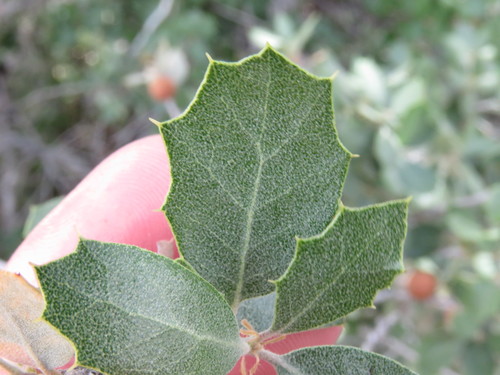
This evergreen shrub typically grows between 1 to 3 meters tall, displaying a rigid, intricately branched form. Its leathery leaves are distinctly bicolored: a dull, grayish-green on top and a striking, felt-like white or light gray underneath, covered in minute star-shaped hairs. The leaves are generally oval, with smooth margins or a few small teeth near the tips. In autumn, it produces cylindrical, yellowish-brown acorns nestled in deeply bowl-shaped cups with thickened, warty scales.
Categoría
PlantasRareza
Common
Peligro
1/5 · Muy bajo
Snaps
¡Sé la primera persona en hacer un snap!
Muller's Oak frequently hybridizes with other local scrub oak species, creating intermediate forms that can stump even experienced botanists.
The white, felt-like hairs on the underside of its leaves are actually star-shaped when viewed under a magnifying glass, a feature designed to conserve water.
This species was named in honor of Cornelius Herman Muller, an American botanist who was one of the world's leading experts on oaks.
The dense, star-shaped hairs on the leaf undersides trap moisture and reflect harsh desert sunlight, drastically reducing water loss.
Possesses a woody root crown that stores nutrients, allowing the plant to rapidly sprout new shoots after wildfire destroys its canopy.
Extends deep taproots into rocky crevices to access subterranean water tables unavailable to shallower-rooted shrubs.
As an autotrophic plant, Muller's Oak generates its own energy through photosynthesis, utilizing sunlight, carbon dioxide, water, and soil nutrients.
Neotoma bryanti
Feeds on the acorns and leaves, and utilizes twigs to construct complex middens.
Aphelocoma californica
Collects and caches acorns, inadvertently planting new oaks by forgetting some of their stores.
Ovis canadensis nelsoni
Browses the evergreen foliage and twigs during dry seasons when other forage is scarce.
Aún no hay insignias de rasgos asignadas a este objeto.
Todavía no hay alias listados.
Las colecciones para este objeto aparecerán aquí a medida que se añadan más temas.
Peligro
1/5 · Muy bajo
Todavía no hay notas especiales de seguridad.
La forma más fácil de identificar a Muller'S Oak es usar la aplicación de identificación de naturaleza Snappit.
100+ cm
50+ años
As an autotrophic plant, Muller's Oak generates its own energy through photosynthesis, utilizing sunlight, carbon dioxide, water, and soil nutrients.
Found on arid slopes, desert-transition chaparral, and pinyon-juniper woodlands of Southern California and northern Baja California.
Acércate para separar los grupos y explorar dónde se ha fotografiado este objeto.
Los snaps recientes aparecerán aquí a medida que se añadan nuevas observaciones.








