

Narrow-Leaved Ash
fraxinus angustifolia
The Narrow-Leaved Ash (Fraxinus angustifolia) is a deciduous tree native to Southern Europe, North Africa, and Southwest Asia. It is highly valued for its elegant appearance, fast growth, and resilience, making it a common sight in riparian zones and cultivated landscapes. This species plays a crucial ecological role in stabilizing riverbanks and providing habitat for various species, though it faces significant threats from diseases such as ash dieback. Its adaptability to varying soil conditions and moisture levels contributes to its widespread distribution and ecological importance.
Hábitat: Found primarily along riverbanks, in moist woodlands, and in alluvial forests, thriving in areas with consistent soil moisture.
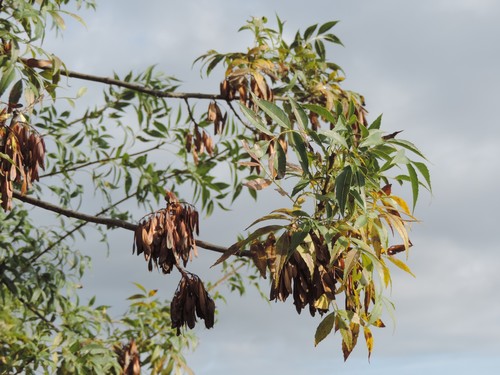
This medium to large deciduous tree typically grows with a broad, rounded crown. Its bark is smooth and pale grey when young, becoming fissured and darker with age. The leaves are pinnately compound, meaning they consist of multiple leaflets arranged along a central stem. These leaflets are characteristically narrow, lance-shaped, with serrated margins, and a glossy dark green color, turning vibrant yellow in autumn. The tree produces small, inconspicuous flowers in spring, followed by distinctive winged seeds known as samaras, which often hang in clusters.
Categoría
PlantasRareza
Common
Peligro
1/5 · Muy bajo
Snaps
¡Sé la primera persona en hacer un snap!
In some traditional cultures, ash trees were considered sacred and associated with protection, healing, and fertility.
It is one of the few Fraxinus species that can tolerate a wide range of soil moisture conditions, from periodically flooded to relatively dry.
The species is often dioecious, meaning individual trees bear either male or female flowers, though some trees can be monoecious or hermaphroditic.
The wood of the Narrow-Leaved Ash is known for its strength, elasticity, and shock resistance, making it valuable for tools, sports equipment, and furniture.
Narrow-Leaved Ash is well-adapted to periodic inundation, capable of surviving prolonged periods of waterlogged soil, making it ideal for riparian environments.
Once established, this species exhibits considerable tolerance to drier conditions, allowing it to persist in areas that experience seasonal drought.
Its extensive and robust root system effectively binds soil particles, preventing erosion along riverbanks and in other vulnerable areas.
As a plant, the Narrow-Leaved Ash produces its own food through photosynthesis, converting sunlight into energy. It absorbs carbon dioxide from the atmosphere and nutrients from the soil.
Hymenoscyphus fraxineus
Pathogen causing severe disease
Hylesinus fraxini
Herbivore feeding on sap and bark
Columba palumbus
Seed dispersal agent
Various species
Symbiotic association with roots
Aún no hay insignias de rasgos asignadas a este objeto.
Todavía no hay alias listados.
Las colecciones para este objeto aparecerán aquí a medida que se añadan más temas.
Peligro
1/5 · Muy bajo
Todavía no hay notas especiales de seguridad.
La forma más fácil de identificar a Narrow-Leaved Ash es usar la aplicación de identificación de naturaleza Snappit.
1500-3000 cm
500-20000 kg
80-200 años
As a plant, the Narrow-Leaved Ash produces its own food through photosynthesis, converting sunlight into energy. It absorbs carbon dioxide from the atmosphere and nutrients from the soil.
Found primarily along riverbanks, in moist woodlands, and in alluvial forests, thriving in areas with consistent soil moisture.
Acércate para separar los grupos y explorar dónde se ha fotografiado este objeto.
Los snaps recientes aparecerán aquí a medida que se añadan nuevas observaciones.