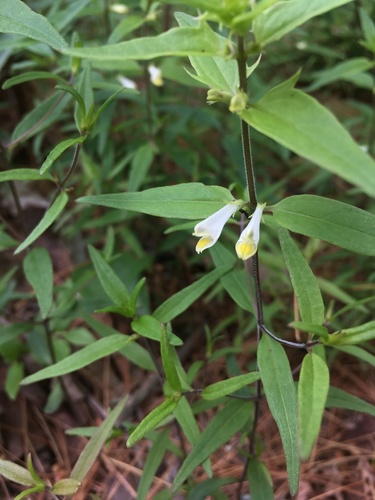


Narrowleaf Cow Wheat
melampyrum lineare
Narrowleaf Cow Wheat (Melampyrum lineare) is a fascinating, delicate annual wildflower native to the woodlands and barrens of North America. Belonging to the broomrape family (Orobanchaceae), it is a hemiparasite, meaning that while it is green and capable of photosynthesis, it actively taps into the root systems of neighboring plants to steal water and vital nutrients. This dual lifestyle allows it to thrive in nutrient-poor, acidic soils where other plants might struggle. It plays a subtle yet key role in its forest ecosystems, influencing the growth of dominant shrubs and trees without causing them severe harm.
Hábitat: Found in dry, acidic soils of coniferous or mixed forests, sandy pine barrens, and rocky ridges across northern North America.
This slender, branching annual typically grows between 10 and 50 centimeters tall, featuring opposite, narrow, linear-to-lanceolate green leaves along delicate, wiry stems. In summer, it produces small, tube-shaped flowers that are creamy white or pale yellow, often tinged with purple or yellow at the tip, which sit in the axils of leaf-like bracts. These bracts are notable for having sharp, tooth-like lobes near their base, distinguishing this plant from similar species.
Categoría
PlantasRareza
Common
Peligro
1/5 · Muy bajo
Snaps
¡Sé la primera persona en hacer un snap!
Despite stealing resources from neighboring plants, research shows that Narrowleaf Cow Wheat does not typically kill its hosts, maintaining a balanced relationship within the forest floor community.
Its genus name, Melampyrum, translates from Greek to 'black wheat', referring to the tendency of the seeds to turn flour black if accidentally harvested and ground with wheat.
The seeds of Narrowleaf Cow Wheat possess a fleshy structure called an elaiosome, which attracts ants; the ants carry the seeds to their nests, eat the nutrient-rich elaiosome, and discard the seed, effectively planting it.
Utilizes specialized root-like structures called haustoria to pierce the roots of neighboring plants, extracting water and minerals.
Produces seeds with nutrient-rich elaiosomes that entice ants to carry and plant the seeds safely underground near host roots.
Thrives in heavily shaded forest understories by combining low-light photosynthesis with parasitic nutrient absorption.
Generates organic compounds through photosynthesis while extracting water, nitrogen, and minerals from host plants via underground root connections.
Diferencias por edad: Seedlings rely initially on seed reserves before establishing parasitic root connections and developing photosynthetic leaves.
Pinus banksiana
Acts as a hemiparasite, tapping into the roots of this pine tree to steal water and minerals.
Vaccinium angustifolium
Frequently parasitizes the root system of this common understory shrub.
Formica neorufibarbis
Carries the seeds back to their nests to feed on the elaiosomes, facilitating seed dispersal.
Aún no hay insignias de rasgos asignadas a este objeto.
Todavía no hay alias listados.
Las colecciones para este objeto aparecerán aquí a medida que se añadan más temas.
Peligro
1/5 · Muy bajo
Todavía no hay notas especiales de seguridad.
La forma más fácil de identificar a Narrowleaf Cow Wheat es usar la aplicación de identificación de naturaleza Snappit.
10-50 cm
1 años
Generates organic compounds through photosynthesis while extracting water, nitrogen, and minerals from host plants via underground root connections.
Found in dry, acidic soils of coniferous or mixed forests, sandy pine barrens, and rocky ridges across northern North America.
Parasitism
Acércate para separar los grupos y explorar dónde se ha fotografiado este objeto.
Los snaps recientes aparecerán aquí a medida que se añadan nuevas observaciones.




_Ajuga_reptans_-plant_habit.jpg&width=800)




.jpg&width=800)




