

Narrowleaf Milkweed
asclepias fascicularis
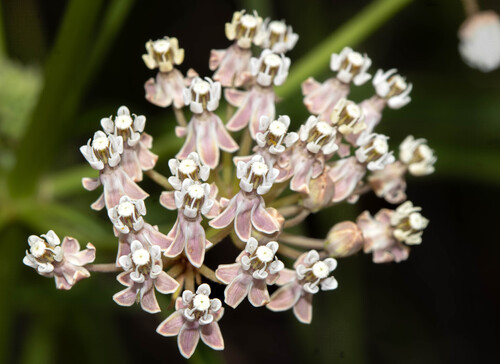
Narrowleaf Milkweed (Asclepias fascicularis) is a resilient perennial herb native to the western United States. Highly prized by gardeners and conservationists alike, this plant features slender, lance-shaped leaves and dense, rounded clusters of delicate, star-shaped white-to-lavender flowers. It serves as a vital ecological cornerstone in its native range, supporting a myriad of pollinating insects and acting as a critical host plant for the iconic Monarch butterfly.
Hábitat: Typically found in dry, open habitats including valleys, foothills, chaparral, deserts, grasslands, and along roadsides.
This plant typically grows upright to a height of 50 to 100 cm. It is easily distinguished by its exceptionally narrow, linear leaves that grow in tight whorls or opposite pairs along the slender, greenish-purple stems. From late spring to early autumn, the plant produces rounded, umbrella-like clusters of small, 5-petaled flowers which range in color from greenish-white to pale pink or lavender. After pollination, it develops smooth, slender, teardrop-shaped seed pods that eventually split open to release flat, brown seeds attached to silky, white fluff.
Categoría
PlantasRareza
Common
Peligro
1/5 · Muy bajo
Snaps
¡Sé la primera persona en hacer un snap!
Indigenous peoples historically harvested the strong, fibrous stems of this plant to weave high-quality ropes, nets, and bowstrings.
The plant's milky sap contains toxic cardiac glycosides, which monarch caterpillars safely ingest to make themselves highly unpalatable to birds.
Unlike most flowers that have loose pollen, milkweed packages its pollen into tiny, sticky sacks called pollinia that clip onto the legs of visiting insects.
Synthesizes toxic cardiac glycosides within its milky white sap to deter generalist herbivores from eating its foliage.
Utilizes a deep, extensive taproot system to access water deep within dry, clay-heavy soils during hot summer months.
Produces seeds equipped with silky, lightweight hairs that catch the wind, allowing them to disperse over great distances.
As a photoautotrophic plant, it produces its own sugars through photosynthesis, utilizing sunlight, carbon dioxide, and water while absorbing essential minerals through its root system.
Danaus plexippus
Serves as a critical host plant and food source for Monarch butterfly caterpillars, which sequester the plant's toxins for their own defense.
Oncopeltus fasciatus
Sucking insects that feed on the seeds, leaves, and stems of the milkweed plant.
Apis mellifera
Visits the flowers for nectar and acts as an efficient pollinator of the plant.
Aún no hay insignias de rasgos asignadas a este objeto.
Todavía no hay alias listados.
Las colecciones para este objeto aparecerán aquí a medida que se añadan más temas.
Peligro
1/5 · Muy bajo
Todavía no hay notas especiales de seguridad.
La forma más fácil de identificar a Narrowleaf Milkweed es usar la aplicación de identificación de naturaleza Snappit.
50-100 cm
3-10 años
As a photoautotrophic plant, it produces its own sugars through photosynthesis, utilizing sunlight, carbon dioxide, and water while absorbing essential minerals through its root system.
Typically found in dry, open habitats including valleys, foothills, chaparral, deserts, grasslands, and along roadsides.
Acércate para separar los grupos y explorar dónde se ha fotografiado este objeto.
Los snaps recientes aparecerán aquí a medida que se añadan nuevas observaciones.