

Narrowleaf Vervain
verbena simplex
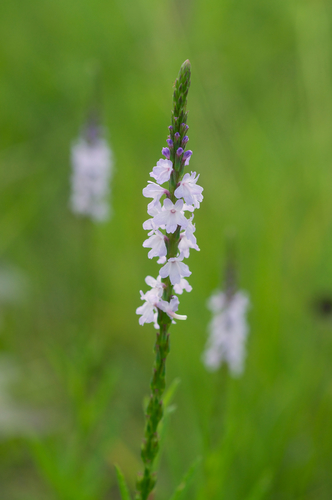
Narrowleaf Vervain (Verbena simplex) is a slender, resilient perennial herb native to eastern and central North America. Belonging to the verbena family, this delicate plant is highly valued in its native ecosystems for its exceptional drought tolerance and ability to thrive in poor, shallow soils. It is often found anchoring the plant communities of limestone glades, dry prairies, and open rocky woodlands where other species might struggle to survive. Despite its unassuming stature, Narrowleaf Vervain plays a crucial role as a native nectar source. As summer progresses, its long, wand-like floral spikes erupt with tiny, vivid pale lavender to violet flowers. These blooms open sequentially from the bottom of the spike to the top, providing a sustained and reliable food supply for a wide variety of small native bees, butterflies, and skippers over several weeks.
Hábitat: Found in dry, sandy, or rocky soils, typically inhabiting limestone glades, upland prairies, savannas, pastures, and sun-baked roadsides.
Typically growing between 20 and 60 centimeters tall, Narrowleaf Vervain is characterized by its slender, often unbranched, purplish-green stems. Its distinctive leaves are opposite, narrowly lance-shaped (up to 8 cm long but only a few millimeters wide), with subtly toothed margins and a slightly rough texture. At the apex of the stem, it produces dense, narrow floral spikes that bear tiny, five-lobed tubular flowers. The blooms range in color from pale lavender to deep purple and usually open a few at a time in a ring that slowly moves upward along the spike.
Categoría
PlantasRareza
Common
Peligro
1/5 · Muy bajo
Snaps
¡Sé la primera persona en hacer un snap!
Because it thrives in thin, rocky soils over limestone bedrock, Narrowleaf Vervain is often used by ecologists as an indicator species to identify remnant glade ecosystems.
By blooming bottom-to-top over several weeks, a single Narrowleaf Vervain plant creates a built-in 'nectar calendar' that sustains native insects during the hottest, driest parts of summer.
Its specific epithet 'simplex' translates to 'simple' or 'unbranched', contrasting it with other verbena species that typically have heavily branched stems.
The genus name 'Verbena' is an ancient Latin word meaning 'sacred bough', referring to the historical use of vervains in European religious and medicinal ceremonies.
Utilizes a deep taproot and narrow leaves that minimize water loss, allowing it to survive harsh, dry conditions in shallow, rocky soils.
Flowers open continuously from the bottom of the spike to the top, extending the plant's reproductive period and providing a prolonged nectar source.
Specifically adapted to thrive in highly alkaline, calcium-rich soils typical of limestone glades, giving it a competitive edge over less specialized plants.
As a photosynthetic plant, it synthesizes its own food using sunlight, carbon dioxide, and water.
Calliopsis verbenae
Specialist bee species that relies almost exclusively on the pollen and nectar of Verbena species.
Crambodes talidiformis
The caterpillars of this moth species feed specifically on the foliage and flowers of Verbena plants.
Junonia coenia
Adult butterflies frequently visit the flowers of Narrowleaf Vervain to feed on its nectar.
Aún no hay insignias de rasgos asignadas a este objeto.
Todavía no hay alias listados.
Las colecciones para este objeto aparecerán aquí a medida que se añadan más temas.
Peligro
1/5 · Muy bajo
Todavía no hay notas especiales de seguridad.
La forma más fácil de identificar a Narrowleaf Vervain es usar la aplicación de identificación de naturaleza Snappit.
20-60 cm
2-5 años
As a photosynthetic plant, it synthesizes its own food using sunlight, carbon dioxide, and water.
Found in dry, sandy, or rocky soils, typically inhabiting limestone glades, upland prairies, savannas, pastures, and sun-baked roadsides.
Photosynthesis
14-28 días
Acércate para separar los grupos y explorar dónde se ha fotografiado este objeto.
Los snaps recientes aparecerán aquí a medida que se añadan nuevas observaciones.













