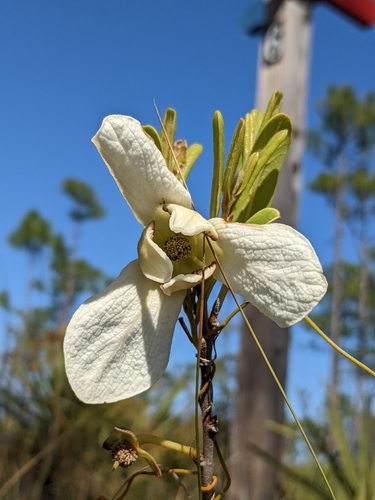


Netted Pawpaw
asimina reticulata
The Netted Pawpaw (Asimina reticulata) is an enchanting, low-growing woody shrub endemic to the pine flatwoods and sandhill communities of Florida and southern Georgia. Belonging to the custard apple family (Annonaceae), this resilient plant is celebrated for its stunning, creamy-white flowers that emerge in early spring, often carpeting the forest floor before other vegetation awakens. Its common name derives from the conspicuous, net-like pattern of veins on its leathery, dark green leaves. Historically adapted to the frequent, low-intensity wildfires of the southeastern United States, the Netted Pawpaw has developed a robust survival strategy. It plays a vital ecological role, acting as an essential host plant for specialized insects and offering sweet, custard-like fruits to a variety of native wildlife, making it a true cornerstone of the Florida scrub.
Hábitat: Found in open pine flatwoods, sandhills, and scrubby areas, typically thriving in sandy, well-draining soils with frequent fire exposure.
This small, deciduous to semi-evergreen shrub typically grows between 50 and 150 centimeters in height. Its most identifying feature is the net-like (reticulate) venation prominent on the undersides of its oblong, leathery leaves, which release a green-pepper scent when bruised. During early spring, it produces elegant, solitary, nodding flowers consisting of three large, creamy-white outer petals and three smaller, maroon-blushed inner petals. The flowers give way to small, oblong, greenish-yellow fruits that turn dark brown when fully ripe.
Categoría
PlantasRareza
Common
Peligro
1/5 · Muy bajo
Snaps
¡Sé la primera persona en hacer un snap!
It is a fire-dependent species, often producing its best floral displays immediately after a wildfire has swept through its habitat.
The sweet, custard-like fruits are highly prized by native wildlife, but they must be eaten quickly as they spoil within days of ripening.
When crushed, the leaves of the Netted Pawpaw release a distinct fragrance resembling green bell peppers or asphalt.
Equipped with a deep, robust taproot, it can quickly resprout and flower within weeks after a wildfire has cleared the canopy.
The leaves contain acetogenins, natural insecticidal compounds that deter most herbivores but serve as a chemical shield for specialized caterpillars.
Its flowers emit a yeasty, fermenting scent to selectively attract beetles and flies for pollination, rather than relying on bees.
As a photoautotroph, the Netted Pawpaw produces its own energy via photosynthesis, utilizing sunlight, water, and carbon dioxide from its sandy environment.
Protographium marcellus
The caterpillars of this butterfly feed exclusively on the leaves of the Netted Pawpaw, absorbing toxic compounds for self-defense.
Gopherus polyphemus
Forages on the sweet, ripe fallen fruits of the pawpaw on the forest floor, helping disperse its seeds.
Trichiotinus piger
Pollinates the flowers while searching for yeast-like odors, feeding on the pollen and nectar.
Aún no hay insignias de rasgos asignadas a este objeto.
Todavía no hay alias listados.
Las colecciones para este objeto aparecerán aquí a medida que se añadan más temas.
Peligro
1/5 · Muy bajo
Todavía no hay notas especiales de seguridad.
La forma más fácil de identificar a Netted Pawpaw es usar la aplicación de identificación de naturaleza Snappit.
50+ cm
15+ años
As a photoautotroph, the Netted Pawpaw produces its own energy via photosynthesis, utilizing sunlight, water, and carbon dioxide from its sandy environment.
Found in open pine flatwoods, sandhills, and scrubby areas, typically thriving in sandy, well-draining soils with frequent fire exposure.
Acércate para separar los grupos y explorar dónde se ha fotografiado este objeto.
Los snaps recientes aparecerán aquí a medida que se añadan nuevas observaciones.



_Allium_vineale_-_inflorescence_immature.jpg&width=800)