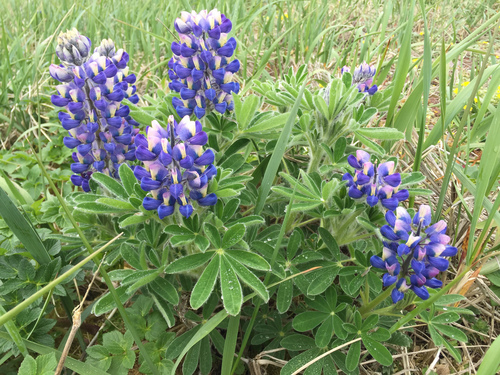


Nootka Lupine
lupinus nootkatensis
The Nootka Lupine, scientific name Lupinus nootkatensis, is a vibrant perennial wildflower native to the coastal regions of the Pacific Northwest. Renowned for its striking spires of blue-purple flowers, it is a prominent feature of meadows, coastal bluffs, and disturbed areas. Beyond its aesthetic appeal, this member of the pea family plays a crucial ecological role as a nitrogen fixer, enriching the soil and supporting other plant life in often nutrient-poor environments. Its resilience and ability to colonize barren landscapes make it an important pioneer species in ecological succession.
Hábitat: Nootka Lupine is typically found in coastal meadows, bluffs, open woodlands, clearings, roadsides, and other disturbed sites, thriving in well-drained soils.
Nootka Lupine presents as an upright herbaceous perennial, typically growing between 30 to 100 centimeters tall. Its most distinctive features are the dense, towering spires of pea-like flowers, which are usually a brilliant blue or purplish-blue, sometimes with hints of white or pink. The leaves are palmate, arranged in a rosette at the base and alternately along the stem, each composed of 7 to 11 narrow, oval leaflets radiating from a central point. Stems and leaves are often covered in fine, silky hairs, giving the plant a somewhat soft, silvery appearance.
Categoría
PlantasRareza
Common
Peligro
1/5 · Muy bajo
Snaps
¡Sé la primera persona en hacer un snap!
Indigenous peoples of the Pacific Northwest traditionally used Nootka Lupine for various purposes, including some medicinal uses and fiber, though careful preparation was required due to its toxicity.
The genus name 'Lupinus' comes from the Latin word 'lupus,' meaning 'wolf,' as ancient Romans believed lupines 'wolfed' nutrients from the soil, though we now know they enrich it.
While beautiful, many parts of the Nootka Lupine, especially the seeds, contain toxic alkaloids that can be harmful if ingested by livestock or humans.
Through a symbiotic relationship with Rhizobium bacteria in its root nodules, Nootka Lupine converts atmospheric nitrogen into a usable form, enriching the soil for itself and surrounding plants.
This species can readily establish itself in nutrient-poor or recently disturbed soils, acting as a crucial pioneer plant that improves soil quality and facilitates the growth of other flora.
Nootka Lupine produces bitter and toxic alkaloids throughout its tissues, deterring most herbivores from consuming its leaves, stems, and seeds, thereby protecting itself from predation.
As a photosynthetic organism, Nootka Lupine produces its own food (sugars) from sunlight, water, and carbon dioxide. It also absorbs essential minerals and fixed nitrogen from the soil.
Bombus spp.
Pollinates flowers, collecting nectar and pollen
Rhizobium leguminosarum
Forms symbiotic relationship in root nodules to fix nitrogen
Odocoileus hemionus columbianus
Browses on leaves and shoots, especially in early growth stages
Selasphorus rufus
Feeds on nectar and pollen, aiding in pollination
Aún no hay insignias de rasgos asignadas a este objeto.
Todavía no hay alias listados.
Las colecciones para este objeto aparecerán aquí a medida que se añadan más temas.
Peligro
1/5 · Muy bajo
Todavía no hay notas especiales de seguridad.
La forma más fácil de identificar a Nootka Lupine es usar la aplicación de identificación de naturaleza Snappit.
30-100 cm
2-7 años
As a photosynthetic organism, Nootka Lupine produces its own food (sugars) from sunlight, water, and carbon dioxide. It also absorbs essential minerals and fixed nitrogen from the soil.
Nootka Lupine is typically found in coastal meadows, bluffs, open woodlands, clearings, roadsides, and other disturbed sites, thriving in well-drained soils.
Photosynthesis And Nutrient Absorption
Acércate para separar los grupos y explorar dónde se ha fotografiado este objeto.
Los snaps recientes aparecerán aquí a medida que se añadan nuevas observaciones.











