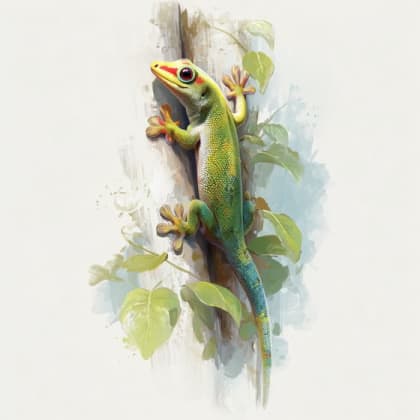
North African Spiny-tailed Lizard
Uromastyx acanthinura
The North African Spiny-tailed Lizard is a colorful lizard that loves warm, sunny places. It has a spiky tail that helps it dig and stay safe from predators.
Hábitat: Desert
The North African Spiny-tailed Lizard is a stocky reptile with a flattened body, covered in rough, yellowish-brown scales that offer excellent camouflage against desert rocks. Its most distinctive feature is a heavy, muscular tail armed with rows of sharp, spiky scales, making it look quite formidable.
Categoría
ReptilesRareza
Common
Peligro
1/5 · Muy bajo
Snaps
¡Sé la primera persona en hacer un snap!
Their skin can change color to help them warm up faster or cool down.
These lizards have special salt glands that help them "sneeze out" extra salt!
They often use their spiky tails to block burrow entrances from predators.
They puff up their bodies with air to look huge and scare away enemies!
The North African Spiny-tailed Lizard can swing its powerful, spike-covered tail as a shield to deter predators, making it hard to attack.
North African Spiny-tailed Lizards can dig deep burrows to escape extreme desert heat or cold, creating their own comfortable homes.
North African Spiny-tailed Lizards get vital water from plants they eat, because their efficient kidneys minimize water loss.
Mostly eats desert plants like leaves, flowers, and seeds, occasionally snacking on insects.
Diferencias por edad: Young lizards might eat more insects for protein, becoming almost exclusively plant-eaters as adults.
Vulpes zerda
Fennec foxes are known predators of desert reptiles.
Varanus griseus
Large desert monitors can prey on adult and juvenile lizards.
Vachellia tortilis
Lizards feed on the leaves and seeds of desert acacia trees.
Zilla spinosa
A common desert plant that provides food and hydration.
Los animales solitarios viven solos durante la mayor parte de su vida y solo interactúan con otros para aparearse o cuidar de sus crías.
Colorido describe a organismos u objetos que exhiben una amplia variedad de colores brillantes y distintivos.
Los animales excavadores cavan túneles y cámaras en el suelo y utilizan estas estructuras subterráneas para refugiarse, cazar o reproducirse.
Este rasgo caracteriza a los organismos cuya dieta consiste total o principalmente en material vegetal.

Los hábitats desérticos son regiones áridas caracterizadas por precipitaciones extremadamente bajas y, a menudo, temperaturas extremas, que albergan una flora y fauna especializadas.

Posee proyecciones puntiagudas y afiladas o espinas en el cuerpo o en la superficie.

Este rasgo caracteriza a los organismos con una esperanza de vida excepcionalmente larga en comparación con otros de su especie.

Los animales diurnos están activos principalmente durante el día y suelen descansar o dormir por la noche.
Todavía no hay alias listados.
Peligro
1/5 · Muy bajo
Always watch from a distance and don’t try to touch wild lizards.
25-45 cm
0.2-1 kg
15-25 años
25 km/h
Mostly eats desert plants like leaves, flowers, and seeds, occasionally snacking on insects.
Desert
Foraging
10-25
Acércate para separar los grupos y explorar dónde se ha fotografiado este objeto.
Los snaps recientes aparecerán aquí a medida que se añadan nuevas observaciones.