

North American Common Gray
anavitrinella pampinaria
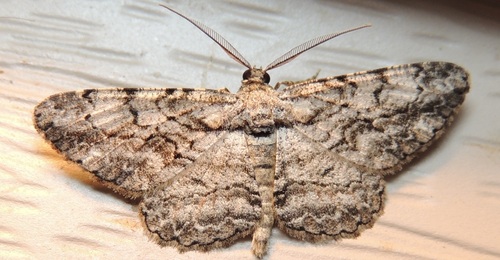
The North American Common Gray (Anavitrinella pampinaria) is a master of disguise in the moth world. Found widely across North American deciduous forests and suburban gardens, this subtle insect blends seamlessly into its surroundings, making it a delight for sharp-eyed nature spotters. As a member of the family Geometridae, its caterpillars are classic 'inchworms' that move with a charming looping gait. These moths play a vital role in their ecosystems as both herbivores during their larval stage and as a critical food source for bats, birds, and other nocturnal predators.
Hábitat: Found in deciduous forests, mixed woodlands, suburban gardens, and orchards where their larval host plants are abundant.
Adults of this species feature a wingspan ranging from 2.2 to 3.8 cm, with wings heavily mottled in shades of gray, white, and dusky brown. They display fine, dark, wavy lines running horizontally across both the forewings and hindwings, which mimic the cracks and crevices of tree bark. When resting, they hold their wings flat against the substrate, eliminating shadows and enhancing their camouflage. The caterpillars are highly variable, ranging from light green to deep brown, often mimicking small twigs.
Categoría
InsectosRareza
Common
Peligro
1/5 · Muy bajo
Snaps
¡Sé la primera persona en hacer un snap!
Adults always rest with their wings held entirely flat against surfaces, which eliminates cast shadows and prevents visual detection by predators.
The common name 'inchworm' comes from the looping motion of the caterpillars, which historically made it look like they were measuring the earth inch by inch.
To escape hungry birds, the caterpillars can stiffen their bodies at an angle from branches to perfectly mimic a broken twig.
The intricate gray and white wing patterns perfectly match lichen-covered tree bark, rendering the resting moth nearly invisible to predators.
To escape avian predators, the caterpillars can stiffen their bodies and stand at an angle from a branch, perfectly mimicking a dead twig.
Adults possess tympanic organs capable of detecting ultrasonic bat echolocation, prompting them to perform rapid evasive diving maneuvers.
Larvae feed on the leaves of various deciduous trees and shrubs, while adults occasionally sip nectar and moisture.
Diferencias por edad: Caterpillars chew on leafy foliage, whereas the adult moths sip nectar or fluids using a proboscis.
Prunus serotina
The leaves of the Black Cherry tree serve as a primary food source for the Common Gray caterpillars.
Myotis lucifugus
The Little Brown Bat is a major nocturnal predator of adult Common Gray moths.
Cyanocitta cristata
Blue Jays forage in deciduous foliage and frequently consume both Common Gray larvae and resting adults.
Aún no hay insignias de rasgos asignadas a este objeto.
Todavía no hay alias listados.
Las colecciones para este objeto aparecerán aquí a medida que se añadan más temas.
Peligro
1/5 · Muy bajo
Todavía no hay notas especiales de seguridad.
La forma más fácil de identificar a North American Common Gray es usar la aplicación de identificación de naturaleza Snappit.
0.00010124300350105316+ kg
Larvae feed on the leaves of various deciduous trees and shrubs, while adults occasionally sip nectar and moisture.
Found in deciduous forests, mixed woodlands, suburban gardens, and orchards where their larval host plants are abundant.
Foraging
Acércate para separar los grupos y explorar dónde se ha fotografiado este objeto.
Los snaps recientes aparecerán aquí a medida que se añadan nuevas observaciones.