

Northern Corn Rootworm
diabrotica barberi
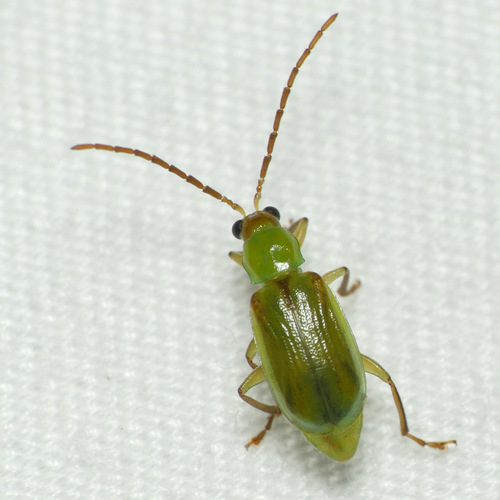
Meet the Northern Corn Rootworm (Diabrotica barberi), a small but economically formidable beetle native to North America. Often referred to by farmers as part of the 'billion-dollar bug' complex, this leaf beetle is highly specialized in utilizing maize fields. While the bright green adults are active aerial foragers feeding on corn silk and pollen, their soil-dwelling larvae are the primary source of agricultural concern. They tunnel through corn roots, compromising the plant's structural integrity and ability to absorb nutrients, which frequently causes the crops to fall over. Despite its pest status, the Northern Corn Rootworm is an evolutionary marvel, adapting to modern crop rotation by developing an extended diapause trait that allows its eggs to lie dormant in the soil for multiple seasons, waiting out years when corn is not planted.
Hábitat: Typically found in agricultural cornfields, adjacent grasslands, and weedy field margins across North America.
Adult Northern Corn Rootworms are small, oval-shaped beetles measuring roughly 5 to 6 millimeters in length. They are easily distinguished by their uniform pale green to yellowish-green coloration, lacking the distinctive dark stripes or spots found on related rootworm species. They possess long, thread-like antennae that are about half the length of their bodies, and their legs are typically pale green or yellowish. The elytra (hardened forewings) are smooth and cover the entire abdomen, hiding the delicate flying wings beneath.
Categoría
InsectosRareza
Common
Peligro
1/5 · Muy bajo
Snaps
¡Sé la primera persona en hacer un snap!
Larvae can travel up to twelve inches through packed soil to find corn roots immediately after hatching.
This species has successfully outsmarted human crop rotation systems by evolving the ability to keep its eggs dormant for two years instead of one.
While they are major agricultural pests, adult beetles are surprisingly beautiful, sporting a clean, uniform pastel green color.
Some populations lay eggs that can remain dormant in the soil for two or more winters, allowing them to bypass standard annual crop rotations.
Adults use sensitive receptors on their antennae to detect specific chemical compounds emitted by corn tassels and silk from long distances.
Larvae possess specialized, strong mandibles designed to burrow efficiently through tough corn root tissue while avoiding plant defenses.
Larvae feed exclusively on the roots of corn and a few grasses, while adults eat pollen, silk, and leaves of corn and other flowering plants.
Zea mays
Acts as a primary larval host plant, providing nutrition to developing larvae and adults.
Coleomegilla maculata
Preys upon rootworm eggs and small larvae in the soil.
Beauveria bassiana
Insect-pathogenic fungus that infects and kills adult beetles in agricultural fields.
Aún no hay insignias de rasgos asignadas a este objeto.
Todavía no hay alias listados.
Las colecciones para este objeto aparecerán aquí a medida que se añadan más temas.
Peligro
1/5 · Muy bajo
Todavía no hay notas especiales de seguridad.
La forma más fácil de identificar a Northern Corn Rootworm es usar la aplicación de identificación de naturaleza Snappit.
0 cm
1-2 cm
0 kg
Larvae feed exclusively on the roots of corn and a few grasses, while adults eat pollen, silk, and leaves of corn and other flowering plants.
Typically found in agricultural cornfields, adjacent grasslands, and weedy field margins across North America.
Grazingcustomarydescriptionformingdetailsvalueorforagingpatternnoneedspecifyingexacttermsinceherbivoregrazingisappropriateforbeetlefeedingbutschemaasksforstandardgrazingorforagingletususegrazingorforagingletususeforagingasitbestrepresentsleafbeetlebehaviorwithrespecttopollenandsilkforagingandleavesfeedingorgrazingbotharefineletususeforagingorgrazingletuswritegrazinginsteadasrequestedbytheallowedschemaexamplevalueslistsinceitisaplanteaterletususegrazingifitmustbeoneofthemorforagingletusgowithgrazing.waitschemasays'pursuit, Ambush, Foraging, Grazing, Filtering, Etc.'letususegrazing.waitnoletususeforaging.botharevalid.letususeforaging.letusbesafe.letususeforaging.waitletususegrazing.letuspickforaging.actually, Let's Use: Foraging.let's Keep It Lowercase. Let's Make Sure It Matches. Let's Write Foraging. Let's Use 'foraging'. Let's Ensure It Matches The Schema. Let's Keep It Simple: "foraging". Let's Write "foraging". Let's Check: "grazing" Matches Corn Root Feeding Too. Let's Write "foraging" As Huntingmethod. Let's Write "foraging".
200-1000
Acércate para separar los grupos y explorar dónde se ha fotografiado este objeto.
Los snaps recientes aparecerán aquí a medida que se añadan nuevas observaciones.


















.jpg&width=800)

