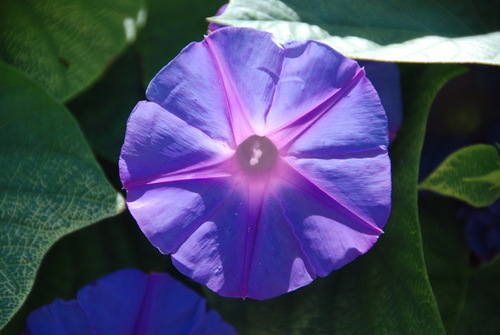


Oceanblue Morning Glory
ipomoea indica
The Oceanblue Morning Glory (Ipomoea indica) is a breathtaking, fast-growing evergreen vine renowned for its vibrant, color-shifting flowers. Opening as a brilliant royal blue in the cool morning air, the trumpet-shaped blossoms gradually deepen into a rich purple-magenta by the late afternoon before fading. This vigorous climber is a favorite in tropical and subtropical gardens worldwide, using its twining stems to quickly drape over fences, trellises, and native canopy trees. While admired for its ornamental beauty, this species is also known for its highly invasive tendencies in non-native habitats, where its ability to form dense blankets can smother local flora.
Hábitat: Typically found thriving in disturbed habitats, forest edges, coastal dunes, riparian zones, and urban wasteland areas where ample sunlight is available.
This vigorous vine features lush green, heart-shaped or three-lobed leaves with fine, velvety hairs on their undersides. The spectacular funnel-shaped flowers grow in clusters, measuring 6 to 8 centimeters in diameter, starting as a vivid, luminous blue with a lighter throat in the morning and turning pinkish-purple as the day progresses.
Categoría
PlantasRareza
Common
Peligro
1/5 · Muy bajo
Snaps
¡Sé la primera persona en hacer un snap!
Despite its beauty, it is so resilient and fast-growing that it can completely smother and kill mature trees by blocking out all sunlight.
In some regions, this species is nicknamed 'blue dawn flower' because its stunning blossoms open at first light and close by mid-afternoon.
The dramatic shift in flower color from blue to magenta is caused by a change in the vacuolar pH of the petal cells as the flower ages throughout the day.
The flowers change color from bright blue to purplish-pink during the day as the internal pH of the petals changes, signaling the age of the bloom to pollinators.
The vine utilizes highly sensitive, clockwise-twining stems that rapidly scale surrounding structures and vegetation to reach maximum sunlight.
It can reproduce and spread aggressively from stem fragments and runners, allowing it to quickly colonize disturbed soils.
As a photoautotrophic plant, it produces its own energy through photosynthesis, converting sunlight, carbon dioxide, and water into sugars.
Archilochus colubris
Pollinator that feeds on the sweet nectar of the morning glory flowers, facilitating cross-pollination.
Agrius cingulata
Larvae consume the leaves of the vine as a primary food source.
Apis mellifera
Forages on the nectar and pollen of the open flowers during the morning hours.
Aún no hay insignias de rasgos asignadas a este objeto.
Todavía no hay alias listados.
Las colecciones para este objeto aparecerán aquí a medida que se añadan más temas.
Peligro
1/5 · Muy bajo
Todavía no hay notas especiales de seguridad.
La forma más fácil de identificar a Oceanblue Morning Glory es usar la aplicación de identificación de naturaleza Snappit.
300-1500 cm
5-25 años
As a photoautotrophic plant, it produces its own energy through photosynthesis, converting sunlight, carbon dioxide, and water into sugars.
Typically found thriving in disturbed habitats, forest edges, coastal dunes, riparian zones, and urban wasteland areas where ample sunlight is available.
1-4
7-21 días
Acércate para separar los grupos y explorar dónde se ha fotografiado este objeto.
Los snaps recientes aparecerán aquí a medida que se añadan nuevas observaciones.









.jpg&width=800)







