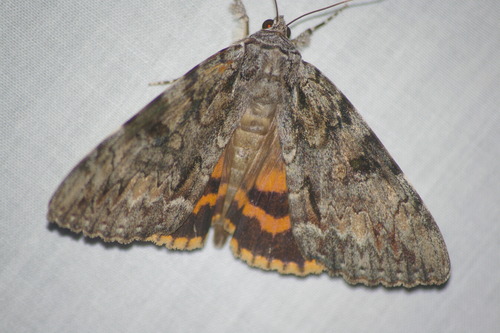


Oldwife Underwing
catocala palaeogama
The Oldwife Underwing (Catocala palaeogama) is a captivating member of the underwing moth family, celebrated for its striking dual-natured appearance. During the day, it rests quietly on the bark of mature deciduous trees, perfectly camouflaged by its intricately patterned, bark-like gray forewings. However, if disturbed by a predator or a curious observer, it dramatically exposes its vibrant orange and black banded hindwings in a sudden, dazzling display designed to startle and confuse. This species is an ecologically important inhabitant of North American hardwood forests, contributing to the food web as both an herbivorous caterpillar and a prey source for various woodland birds and small mammals. Its life cycle is closely tied to the health of walnut and hickory trees, making it a key indicator of mature forest ecosystems.
Hábitat: Typically found in mature deciduous forests and oak-hickory woodlands where its larval host trees are abundant.
This medium-to-large moth has a wingspan of 6 to 8 centimeters. Its forewings are highly cryptic, featuring a complex mixture of gray, brown, and charcoal lines that mimic lichen and tree bark, often showcasing a distinctive pale, double-toothed line. In stark contrast, the hindwings are a brilliant orange-yellow, crossed by two thick, undulating black bands and edged with a clean white fringe, creating a vivid pattern that is completely hidden when the moth is at rest.
Categoría
InsectosRareza
Common
Peligro
1/5 · Muy bajo
Snaps
¡Sé la primera persona en hacer un snap!
Entomologists often attract these moths using a technique called 'sugaring', which involves painting sweet, fermented beer and brown sugar paste on tree trunks.
The scientific genus name Catocala translates from Greek to 'beautiful hindwing', perfectly describing the moth's secret splash of color.
Their caterpillars are also master mimics, matching the color and texture of hickory twigs so perfectly that they are nearly impossible to spot.
Its forewings perfectly mimic the texture and color of lichen-covered tree bark, rendering the moth nearly invisible when resting during the day.
When threatened, it flashes its bright orange and black hindwings to startle predators, giving the moth a critical split second to escape.
Equipped with tympanic organs, it can detect the high-frequency echolocation calls of bats and perform evasive maneuvers in mid-flight.
Caterpillars feed on the leaves of walnut and hickory trees, while the adult moths forage for sugar-rich liquids.
Diferencias por edad: As caterpillars, they eat foliage exclusively; as adults, they transition to a liquid diet of sap, nectar, and decaying organic juices.
Carya ovata
The larvae feed extensively on the foliage of this primary host plant.
Juglans nigra
The larvae occasionally utilize this tree species as an alternative host plant.
Cyanocitta cristata
Adult moths resting on tree bark are actively hunted and eaten by this avian predator.
Aún no hay insignias de rasgos asignadas a este objeto.
Todavía no hay alias listados.
Las colecciones para este objeto aparecerán aquí a medida que se añadan más temas.
Peligro
1/5 · Muy bajo
Todavía no hay notas especiales de seguridad.
La forma más fácil de identificar a Oldwife Underwing es usar la aplicación de identificación de naturaleza Snappit.
34+ cm
68+ cm
0.00020008+ kg
11+ años
15 km/h
Caterpillars feed on the leaves of walnut and hickory trees, while the adult moths forage for sugar-rich liquids.
Typically found in mature deciduous forests and oak-hickory woodlands where its larval host trees are abundant.
Acércate para separar los grupos y explorar dónde se ha fotografiado este objeto.
Los snaps recientes aparecerán aquí a medida que se añadan nuevas observaciones.











.jpg&width=800)



