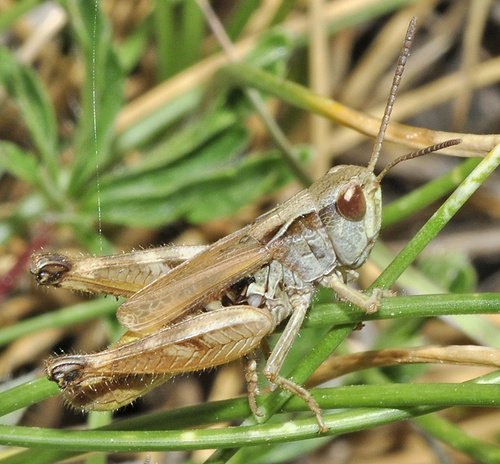


Omocestus Bolivari
omocestus bolivari
Omocestus Bolivari is a fascinating mountain-dwelling grasshopper endemic to the Iberian Peninsula. Thriving in high-altitude grasslands and dry, scrubby pastures, this orthopteran plays a vital role in its ecosystem as both a primary consumer of grasses and a crucial food source for montane birds and reptiles. Like other members of its genus, it is well-known for its acoustic behavior, where males produce a distinct song by rubbing their hind legs against their forewings to attract mates. This species is highly adapted to the dry, sunny conditions of Mediterranean alpine zones, showcasing the incredible biodiversity of European mountain ranges.
Hábitat: Found in high-altitude dry pastures, rocky subalpine grasslands, and open Mediterranean shrublands of the Iberian Peninsula.
This small-to-medium grasshopper typically ranges from 1 to 3 centimeters in length, with females being notably larger and stockier than males. Its coloration is highly cryptic, blending shades of dry brown, grey, and occasionally light green to match its grassy, rocky surroundings. A key identifying feature is its pronotum, which possesses lateral keels that are slightly curved inward, and its long, slender hind legs adapted for powerful jumping. The wings are fully developed, enabling short, buzzing flights when disturbed.
Categoría
InsectosRareza
Common
Peligro
1/5 · Muy bajo
Snaps
¡Sé la primera persona en hacer un snap!
Like many grasshoppers, its ears (tympana) are not on its head, but are located on the sides of its first abdominal segment.
The species relies on high-altitude solar radiation to gain the energy needed for active jumping and calling.
Their eggs undergo a mandatory winter diapause, freezing under mountain snow before hatching in spring.
Males use specialized pegs on their inner hind thighs rubbed against the forewings to produce a buzzing call that attracts females.
This insect alters its posture and body angle relative to the sun to rapidly warm up in cold mountain air or avoid overheating.
Using powerful, enlarged femur muscles, it can leap many times its body length to escape predators in sparse alpine vegetation.
Feeds primarily on a variety of wild grasses and low-growing herbaceous vegetation found in its mountain habitats.
Festuca ovina
Feeds heavily on the leaves of this abundant alpine grass.
Falco naumanni
Preys on these grasshoppers as a major source of protein during the breeding season.
Podarcis hispanicus
Actively hunts grasshoppers and other small insects among the mountain rocks.
Aún no hay insignias de rasgos asignadas a este objeto.
Todavía no hay alias listados.
Las colecciones para este objeto aparecerán aquí a medida que se añadan más temas.
Peligro
1/5 · Muy bajo
Todavía no hay notas especiales de seguridad.
La forma más fácil de identificar a Omocestus Bolivari es usar la aplicación de identificación de naturaleza Snappit.
1+ cm
2+ cm
Feeds primarily on a variety of wild grasses and low-growing herbaceous vegetation found in its mountain habitats.
Found in high-altitude dry pastures, rocky subalpine grasslands, and open Mediterranean shrublands of the Iberian Peninsula.
Grazing
10+
200+ días
Acércate para separar los grupos y explorar dónde se ha fotografiado este objeto.
Los snaps recientes aparecerán aquí a medida que se añadan nuevas observaciones.

















