




Opisthius Richardsoni
opisthius richardsoni
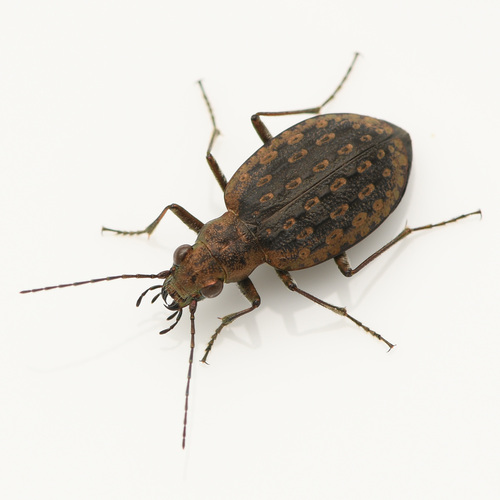
Opisthius richardsoni es un fascinante escarabajo terrestre ribereño nativo del oeste de Norteamérica. Residiendo a lo largo de los márgenes de grava y barro de arroyos fríos y rápidos, este pequeño pero muy activo escarabajo juega un papel esencial como un depredador en miniatura en los ecosistemas de la ribera. Se le ve con frecuencia corriendo rápidamente por bancos de arena abiertos durante los días cálidos y soleados. Lo que hace que este escarabajo sea particularmente fascinante es su asombroso parecido con los escarabajos tigre, lo cual es resultado de una evolución convergente impulsada por sus hábitos de caza diurnos compartidos. Conocido por su increíble velocidad y agudeza visual, este escarabajo es el favorito entre los entomólogos que exploran arroyos de montaña prístinos, y sirve como un excelente indicador de hábitats ribereños sanos y no perturbados.
Hábitat: Se encuentra en las orillas de grava, arena o barro de arroyos y ríos de montaña limpios y de corriente rápida.
Este escarabajo mide típicamente de 8.5 a 11 milímetros de largo, presentando un cuerpo ovalado ligeramente aplanado con un brillo metálico bronce-verde opaco o grisáceo-negro. Sus características más distintivas son sus ojos compuestos excepcionalmente grandes y protuberantes y las filas distintivas de grandes fosas circulares y poco profundas que recubren sus élitros, lo que le da una textura rugosa y con hoyuelos. Posee patas largas y delgadas adaptadas para correr rápidamente, y antenas cortas y filiformes.
Categoría
InsectosRareza
Común
Peligro
1/5 · Muy bajo
Snaps
¡Sé la primera persona en hacer un snap!
A pesar de ser clasificado como un escarabajo terrestre, sus grandes ojos y su comportamiento de carrera hacen que se le confunda frecuentemente con un escarabajo tigre.
El género Opisthius contiene solo esta especie en Norteamérica, lo que lo convierte en un linaje evolutivo muy singular dentro de su subfamilia.
Esta especie está altamente especializada para la vida en la orilla del agua y se sumergirá inmediatamente en el agua o se esconderá bajo la grava si es amenazada por depredadores terrestres.
Usando sus patas alargadas, este escarabajo puede correr a velocidades notables a través de terrenos rocosos irregulares para perseguir presas ágiles.
Equipado con ojos compuestos desproporcionadamente grandes, posee un amplio campo de visión para detectar fácilmente los movimientos de pequeños insectos y depredadores que se aproximan.
Su exoesqueleto especializado repelente al agua le permite sobrevivir a salpicaduras temporales de agua y navegar por rocas ribereñas húmedas y resbaladizas sin ahogarse.
Un depredador voraz, caza activamente pequeños invertebrados en los suelos húmedos de las riberas.
Diferencias por edad: Las larvas viven en madrigueras en la arena húmeda, cazando por emboscada a las presas que pasan, mientras que los adultos persiguen activamente a las presas en la superficie.
Cinclus mexicanus
Depredado por esta ave acuática especializada mientras busca alimento a lo largo de las orillas de los arroyos de montaña.
Isotoma viridis
Caza activamente colémbolos en barro húmedo y grava.
Anaxyrus boreas
Ocasionalmente comido por sapos que cazan a lo largo de las orillas húmedas de los arroyos de montaña.
Peludo describe a los animales que poseen una cubierta densa de pelo o pelaje suave.
Los animales sociales viven en grupos organizados, cooperando para obtener beneficios de supervivencia como la búsqueda de alimento, la defensa y la cría de descendencia.
Este rasgo identifica organismos cuya dieta incluye tanto materia vegetal como animal.
Los animales arborícolas viven principalmente en los árboles, utilizándolos como refugio, alimento y protección contra los depredadores.
Los animales diurnos están activos principalmente durante el día y suelen descansar o dormir por la noche.
Todavía no hay alias listados.
Las colecciones para este objeto aparecerán aquí a medida que se añadan más temas.
Peligro
1/5 · Muy bajo
Todavía no hay notas especiales de seguridad.
Busca élitros duros que se juntan en una línea por el lomo y compara después las antenas, la forma del cuerpo, las patas y las marcas. Los colores metálicos cambian mucho con la luz. Identificador de escarabajos: sube una foto y compara los detalles visibles.
1 cm
0.00005-0.00015 kg
1-2 años
3 km/h
Un depredador voraz, caza activamente pequeños invertebrados en los suelos húmedos de las riberas.
Se encuentra en las orillas de grava, arena o barro de arroyos y ríos de montaña limpios y de corriente rápida.
Persecución
Acércate para separar los grupos y explorar dónde se ha fotografiado este objeto.
Los snaps recientes aparecerán aquí a medida que se añadan nuevas observaciones.
Llévate el descubrimiento
Haz una foto con Snappit, identifica la especie y guarda el hallazgo en tu colección.