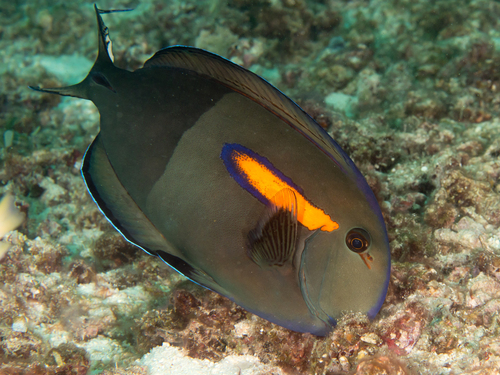


Orangeblotch Surgeonfish
acanthurus olivaceus
The Orangeblotch Surgeonfish (Acanthurus olivaceus), also known as the Orangespot Surgeonfish, is an active marine fish that plays a vital role in maintaining the health of coral reef ecosystems. Found throughout the tropical waters of the Indo-Pacific, this active swimmer is easily recognized by its distinctive color changes and the bold orange streak on its shoulder. Like other surgeonfishes, it possesses sharp, modified scales on either side of its tail base, resembling scalpels, which it uses for self-defense. These fish are busy grazers, spending their days vacuuming up organic detritus, algae, and fine sediments from the seafloor. By cleaning reef surfaces, they prevent algae from smothering delicate corals, making them an indispensable component of coral conservation. Whether observed by divers over outer reef slopes or admired in public aquariums, this species delights onlookers with its graceful movements and striking, mature color transitions.
Hábitat: Typically found in clear, seaward coral reefs, lagoons, and rubble zones at depths between 9 and 46 meters.
Adults of this species display a dark olive-brown to charcoal-gray body, bisected by a vibrant, horizontal orange bar trimmed in deep blue or purple just behind the eye. Their tail is deeply lunate with long, elegant streamers extending from the tips in mature individuals, and they reach a maximum length of around 35 centimeters. In contrast, juveniles are a solid, bright lemon-yellow, which acts as a form of camouflage or mimicry among coral reefs.
Categoría
PecesRareza
Common
Peligro
1/5 · Muy bajo
Snaps
¡Sé la primera persona en hacer un snap!
Its dramatic color change from bright yellow to dark gray is a natural maturity transition, helping sub-adults transition safely into reef territories.
The 'surgeon' in its name refers to the spine at the base of its tail, which is sharp enough to slice open a careless predator or handler like a scalpel.
They form mixed schools with other surgeonfishes and parrotfishes, which helps overwhelm territorial damselfishes guarding premium algae patches.
Unlike many other surgeonfishes that scrape algae directly off hard corals, this species prefers to 'vacuum' the sandy flats around the reefs.
It possesses extremely sharp, retractable spines on either side of its tail base that flip out to defend against predators.
Young fish are bright yellow to blend with venomous or unpalatable yellow damselfish and angelfish, protecting them from predators.
It has a thick-walled stomach designed to digest organic matter mixed with sand and grit ingested while grazing.
Feeds heavily on organic detritus, algae, diatoms, and blue-green algae found on sandy surfaces and coral rubble.
Diferencias por edad: As juveniles, they feed primarily on fine filamentous algae, transitioning to detritus and sand-associated organic matter as adults.
Acropora tenuis
Grazes algae off the reef base, preventing the coral from being smothered.
Carcharhinus melanopterus
Juvenile and adult surgeonfish are preyed upon by reef-dwelling sharks.
Labroides dimidiatus
Visits cleaning stations to have ectoparasites removed from its skin and gills.
Aún no hay insignias de rasgos asignadas a este objeto.
Todavía no hay alias listados.
Las colecciones para este objeto aparecerán aquí a medida que se añadan más temas.
Peligro
1/5 · Muy bajo
Todavía no hay notas especiales de seguridad.
La forma más fácil de identificar a Orangeblotch Surgeonfish es usar la aplicación de identificación de naturaleza Snappit.
20-35 cm
0.3-0.8 kg
25-35 años
15 km/h
Feeds heavily on organic detritus, algae, diatoms, and blue-green algae found on sandy surfaces and coral rubble.
Typically found in clear, seaward coral reefs, lagoons, and rubble zones at depths between 9 and 46 meters.
Grazing
Acércate para separar los grupos y explorar dónde se ha fotografiado este objeto.
Los snaps recientes aparecerán aquí a medida que se añadan nuevas observaciones.




















