

Oregon Anemone
anemonoides oregana
The Oregon Anemone (Anemonoides oregana) is a charming perennial wildflower native to the shady, moist forests of the Pacific Northwest. Rising from a delicate underground rhizome, this spring ephemeral bursts into bloom just as the forest canopy begins to leaf out, blanketing the damp forest floor with splashes of soft color. It is highly valued for its gentle beauty and ecological role in early spring, attracting some of the season's first emerging pollinators. Unlike many garden anemones, this wild species is perfectly adapted to the damp, mossy environments under conifers and deciduous trees, where it quietly thrives in the dappled sunlight.
Hábitat: Found in moist, shady coniferous or mixed forests, thickets, and along stream banks at low to mid-elevations.
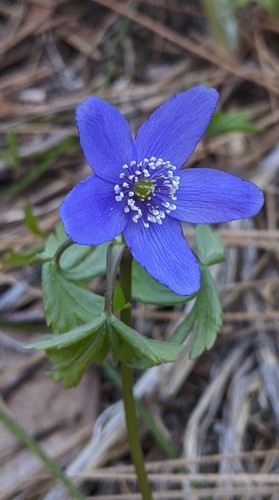
This delicate herb grows between 5 and 30 centimeters tall, featuring a single, slender stem topped by a solitary flower. The blossom, measuring 2 to 4 centimeters across, typically displays five to nine petal-like sepals that range in color from pale blue and violet to pink, reddish-purple, or rarely white. Surrounding a cluster of numerous pale stamens and a central head of pistils, these colorful sepals contrast beautifully with the plant's deeply divided, three-parted deeply-lobed leaves that whorl around the stem just below the flower.
Categoría
PlantasRareza
Common
Peligro
1/5 · Muy bajo
Snaps
¡Sé la primera persona en hacer un snap!
The common name 'windflower' comes from the ancient Greek word 'anemos' (wind), because it was believed the flowers would only open when the wind blew.
The plant contains protoanemonin, a chemical compound that can cause skin irritation, making it unpalatable to most mammalian herbivores.
Unlike many other flowers, the Oregon Anemone does not have true petals; its bright colors come from its modified, petal-like sepals.
Using underground creeping rhizomes, this plant forms clonal colonies that allow it to survive winter and rapidly spread through forest floors.
It emerges and blooms early in spring to capture sunlight before the overhead tree canopy fully closes, maximizing its photosynthetic window.
The roots form relationships with soil fungi, which enhances the plant's nutrient and water absorption in nutrient-competitive forest soils.
As a photosynthetic plant, the Oregon Anemone produces its own organic nutrients using sunlight, water, carbon dioxide, and essential soil minerals.
Bombus melanopygus
Visits the flowers in early spring for pollen, assisting in the plant's pollination.
Odocoileus hemionus
Occasionally browses on the spring foliage of the plant.
Aún no hay insignias de rasgos asignadas a este objeto.
Todavía no hay alias listados.
Las colecciones para este objeto aparecerán aquí a medida que se añadan más temas.
Peligro
1/5 · Muy bajo
Todavía no hay notas especiales de seguridad.
La forma más fácil de identificar a Oregon Anemone es usar la aplicación de identificación de naturaleza Snappit.
5-30 cm
3-10 años
As a photosynthetic plant, the Oregon Anemone produces its own organic nutrients using sunlight, water, carbon dioxide, and essential soil minerals.
Found in moist, shady coniferous or mixed forests, thickets, and along stream banks at low to mid-elevations.
Acércate para separar los grupos y explorar dónde se ha fotografiado este objeto.
Los snaps recientes aparecerán aquí a medida que se añadan nuevas observaciones.