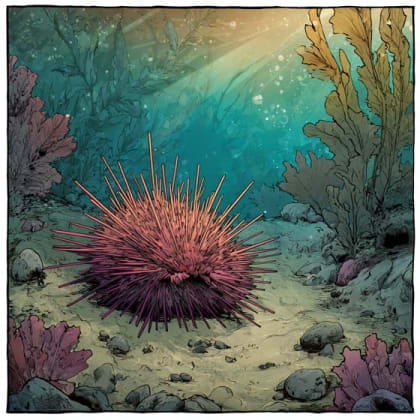
Pacific Acorn Barnacle
balanus glandula
The Pacific Acorn Barnacle is a tiny animal that sticks to rocks and shells in the ocean. They have a hard shell that looks like a little acorn, and they open up to eat tiny food from the water!
Hábitat: Rocky shores and tidal pools along the Pacific coast.
The Pacific Acorn Barnacle is a small, whitish-grey cone with a rough, often ridged surface. Its top has a diamond-shaped opening made of four movable plates. It looks like a tiny volcano glued to rocks, distinct from smooth, flat limpets.
Categoría
InvertebrateRareza
Common
Peligro
0/5 · Sin peligro conocido
Snaps
¡Sé la primera persona en hacer un snap!
Barnacles are actually crustaceans, which means they are related to crabs and lobsters!
Some barnacles can live for many years, often ten times longer than a pet hamster!
They spend their whole adult life upside down, sticking their head to a rock!
Wow! Baby barnacles swim like tiny shrimp before finding a spot to glue down!
Pacific Acorn Barnacle can make an incredibly strong natural cement because of specialized glands that helps them stick to rocks forever.
Pacific Acorn Barnacle has feathery 'cirri' legs that helps them sweep tiny food particles from the ocean water.
Pacific Acorn Barnacle can close its shell plates because of strong muscles that helps them stay safe and moist during low tide.
Pacific Acorn Barnacle has both male and female parts that helps them reproduce even when neighbors are scarce.
They sweep tiny ocean critters and plant bits from the water using their feathery legs.
Pisaster ochraceus
Pries open shells to eat the soft body.
Nucella emarginata
Drills a tiny hole through the shell.
Oligocottus maculosus
Nips at the feathery feeding legs.
Los animales sociales viven en grupos organizados, cooperando para obtener beneficios de supervivencia como la búsqueda de alimento, la defensa y la cría de descendencia.
Los filtradores obtienen nutrientes filtrando partículas de alimentos suspendidos y pequeños organismos del agua.
Los hábitats costeros son entornos dinámicos situados a lo largo de la interfaz entre la tierra y el mar, influenciados por las mareas, las olas y el agua salada.
Los hábitats acuáticos abarcan entornos donde los organismos viven principalmente en el agua, incluidos océanos, ríos, lagos y humedales.

Los hábitats marinos abarcan todos los entornos de agua salada de los océanos de la Tierra, sustentando una inmensa diversidad de vida acuática.
Peligro
0/5 · Sin peligro conocido
Todavía no hay notas especiales de seguridad.
1.5 cm
0.5 g
10 años
They sweep tiny ocean critters and plant bits from the water using their feathery legs.
Rocky shores and tidal pools along the Pacific coast.
Filter Feeding
12
hundreds_to_thousands
Acércate para separar los grupos y explorar dónde se ha fotografiado este objeto.
Los snaps recientes aparecerán aquí a medida que se añadan nuevas observaciones.

British Columbia, CA
Puedes ver Golondrina Común, Pelagic Cormorant y León Marino.
Ver guía →
Washington, US
Puedes ver Arctic Butterbur, Red Valerian y American Brooklime.
Ver guía →
British Columbia, CA
Puedes ver Evergreen Huckleberry, Salal y Pacific Madrone.
Ver guía →