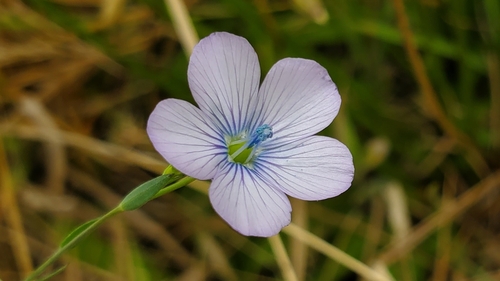


Pale Flax
linum bienne
Pale Flax (Linum bienne) is a delicate, elegant wildflower native to the Mediterranean basin and Western Europe. This slender biennial or short-lived perennial is highly regarded by botanists as the wild ancestor of cultivated flax (Linum usitatissimum), one of the oldest crops domesticated by humanity for fiber and oil. Possessing a quiet, understated beauty, Pale Flax graces sunny meadows, coastal downs, and grassy cliffs, acting as a crucial component of native grassland ecosystems. Its presence offers a living link to the history of human agriculture and textiles.
Hábitat: Found in dry, coastal grasslands, grassy cliffs, and calcareous downs, often on sandy or well-drained soils.
This plant grows up to 60 centimeters tall, featuring very slender, wiry stems that branch near the top. Its leaves are small, narrow, lance-shaped, and arranged alternately along the stem. The flowers are approximately 1 to 1.5 centimeters wide, consisting of five delicate, pale blue, lavender, or nearly white petals decorated with faint, darker blue veins. The central reproductive organs feature blue-tipped anthers, and the resulting fruit is a small, spherical capsule containing glossy brown seeds.
Categoría
PlantasRareza
Common
Peligro
1/5 · Muy bajo
Snaps
¡Sé la primera persona en hacer un snap!
Despite its scientific species name 'bienne' meaning biennial, it frequently acts as a short-lived perennial plant in mild climates.
Its delicate petals open with the morning light but are so fragile that they often drop off the plant by mid-afternoon.
Pale Flax is widely recognized as the wild progenitor of domesticated flax, which has been used to make linen fabrics and linseed oil for over 8,000 years.
Serves as the primary wild genetic reservoir for domesticated flax, preserving natural disease resistance and environmental tolerance.
Maintains the ability to self-fertilize when insect pollinators are scarce, ensuring reliable seed production.
Utilizes a deep taproot and thin, waxy leaves to minimize moisture loss and survive in dry, nutrient-poor coastal soils.
As an autotrophic plant, it produces its own food through photosynthesis using sunlight, carbon dioxide, water, and essential soil minerals.
Apis mellifera
Pollinates the flowers while collecting nectar and pollen.
Longitarsus parvulus
Larvae and adults feed on the leaves and stems of the flax plant.
Aún no hay insignias de rasgos asignadas a este objeto.
Todavía no hay alias listados.
Las colecciones para este objeto aparecerán aquí a medida que se añadan más temas.
Peligro
1/5 · Muy bajo
Todavía no hay notas especiales de seguridad.
La forma más fácil de identificar a Pale Flax es usar la aplicación de identificación de naturaleza Snappit.
10-60 cm
1-3 años
As an autotrophic plant, it produces its own food through photosynthesis using sunlight, carbon dioxide, water, and essential soil minerals.
Found in dry, coastal grasslands, grassy cliffs, and calcareous downs, often on sandy or well-drained soils.
Acércate para separar los grupos y explorar dónde se ha fotografiado este objeto.
Los snaps recientes aparecerán aquí a medida que se añadan nuevas observaciones.












