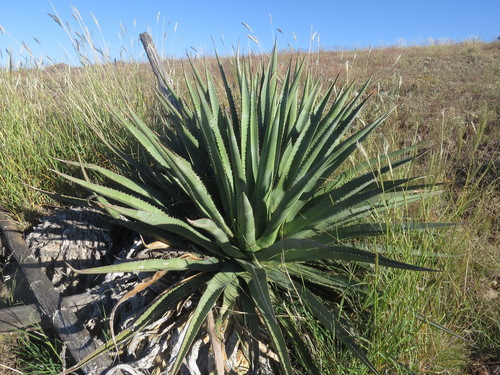


Palmer'S Agave
agave palmeri
Palmer's Agave is a striking, perennial succulent native to the arid grasslands and oak woodlands of the southwestern United States and northern Mexico. It is renowned for its slow-growing, symmetrical rosette of tough, blue-green leaves that store water to survive harsh desert droughts. This resilient plant spends up to thirty years accumulating resources before embarking on a singular, dramatic reproductive event. It produces a towering flower stalk that can reach heights of up to five meters, bursting into vibrant clusters of nectar-rich blossoms before the parent plant ultimately perishes.
Hábitat: Found in dry, rocky soils of semi-desert grasslands, oak woodlands, and desert scrub, typically at elevations between 900 and 2,400 meters.
This species forms a large, dense rosette of thick, lance-shaped leaves that are blue-green to grayish-green in color, reaching diameters of 50 to 120 centimeters. The margins of each leaf are armed with sharp, dark brown teeth, and the leaf tip culminates in a stout, formidable spine. Its most dramatic feature is the massive, branched flowering stalk that rises three to five meters high, bearing clusters of tubular, pale yellow flowers often blushed with pink or red tips.
Categoría
PlantasRareza
Common
Peligro
1/5 · Muy bajo
Snaps
¡Sé la primera persona en hacer un snap!
Because the plant dies after flowering, it relies on producing thousands of winged seeds that are dispersed by the desert winds.
Indigenous peoples traditionally harvested the central 'heart' or cabeza of the agave, roasting it in stone-lined pits for several days to create a sweet, nutritious food source.
Palmer's agave flowers produce an abundance of nectar at night, specifically evolving to attract nocturnal, migrating bats.
It utilizes CAM photosynthesis to conserve water, opening its stomata at night to capture carbon dioxide instead of during the hot desert day.
It channels all its lifetime energy reserves into a single, massive flowering event to maximize pollination and seed production, dying soon after.
The concave shape of its rigid, upright leaves acts as a natural funnel, directing scarce rainwater straight down to its shallow root system.
As a plant, Palmer's agave is a photoautotroph that produces its own energy using sunlight, carbon dioxide, and water through photosynthesis.
Leptonycteris yerbabuana
The lesser long-nosed bat is a critical pollinator of Palmer's agave, feeding on its high-energy nectar during night-time feeding flights.
Choeronycteris mexicana
The Mexican long-tongued bat actively visits the towering blooms at night to drink nectar, assisting in genetic exchange across agave populations.
Scyphophorus acupunctatus
The agave snout weevil burrows into the core of the plant to lay its eggs, which can severely damage or kill the agave.
Aún no hay insignias de rasgos asignadas a este objeto.
Todavía no hay alias listados.
Las colecciones para este objeto aparecerán aquí a medida que se añadan más temas.
Peligro
1/5 · Muy bajo
Todavía no hay notas especiales de seguridad.
La forma más fácil de identificar a Palmer'S Agave es usar la aplicación de identificación de naturaleza Snappit.
50-120 cm
10-50 kg
10-30 años
As a plant, Palmer's agave is a photoautotroph that produces its own energy using sunlight, carbon dioxide, and water through photosynthesis.
Found in dry, rocky soils of semi-desert grasslands, oak woodlands, and desert scrub, typically at elevations between 900 and 2,400 meters.
Acércate para separar los grupos y explorar dónde se ha fotografiado este objeto.
Los snaps recientes aparecerán aquí a medida que se añadan nuevas observaciones.

Arizona, US
Puedes ver Yarrow's Spiny Lizard y Mexican Jay.
Ver guía →

Arizona, US
Puedes ver Mexican Jay, Yarrow's Spiny Lizard y Ciervo De Cola Blanca.
Ver guía →

Arizona, US
Puedes ver Rainbow Hedgehog Cactus y Busardo Colirrojo.
Ver guía →
















.jpg&width=800)
