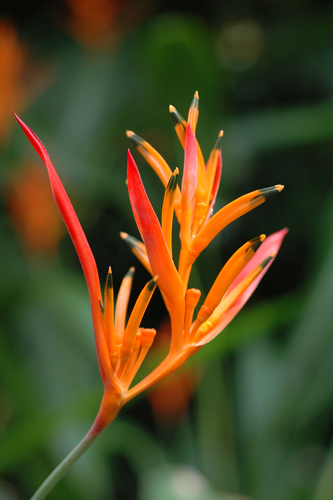


Parrot'S Beak
heliconia psittacorum
Heliconia psittacorum, commonly known as Parrot's Beak, is a striking tropical perennial herb native to the Caribbean and South America. Known for its brilliant, beak-like inflorescences that mimic the vibrant plumage of parrots, this plant is a staple of tropical gardens and wild humid landscapes. It grows from underground rhizomes and features banana-like leaves that provide a lush green backdrop to its fiery orange, yellow, and red bracts. Beyond its aesthetic appeal, Parrot's Beak plays a crucial ecological role. Its nectar-rich flowers are evolutionary magnets for hummingbirds, who act as its primary pollinators. This makes the plant an essential component of tropical food webs, supporting local biodiversity. It is also highly resilient, spreading easily in warm, moist soils, and has become widely naturalized in tropical regions worldwide.
Hábitat: Found in humid tropical regions, thriving in disturbed areas, forest edges, wet pastures, and along riverbanks with moist, well-draining soil.
Heliconia psittacorum is characterized by its erect, reed-like stems growing 1 to 3 meters tall, bearing long-petioled, dark green, lanceolate leaves reminiscent of banana foliage. The outstanding feature is the terminal inflorescence, composed of 3 to 5 slender, boat-shaped bracts. These bracts are typically bright orange to red, fading to yellow at the base, and hold tubular flowers that are greenish-yellow with distinctive dark green or black bands near the tips. The fruit is a small, round, three-lobed drupe that turns bright blue when ripe, containing up to three seeds.
Categoría
PlantasRareza
Common
Peligro
1/5 · Muy bajo
Snaps
¡Sé la primera persona en hacer un snap!
It is often used as a long-lasting cut flower, capable of remaining fresh in a vase for up to two weeks.
Its fruit turns a striking metallic blue when ripe, which highly attracts seed-dispersing tropical birds.
The name 'psittacorum' is Latin for 'of the parrots', referring to the bright flower bracts that resemble a parrot's beak.
Unlike true flowers, the colorful parts of the Parrot's Beak are actually modified leaves called bracts; the true flowers are small and hidden inside.
Brightly colored, boat-like bracts accumulate rainwater and abundant nectar, specialized to attract specific long-billed hummingbird pollinators.
Possesses a vigorous underground rhizome system that allows the plant to rapidly colonize open spaces and survive minor physical damage.
Large, glossy leaves have a thick waxy cuticle that sheds heavy tropical rains easily, preventing fungal growth and leaf damage.
As a photosynthetic plant, it utilizes sunlight, water, and carbon dioxide to produce glucose, drawing essential mineral nutrients through its roots.
Glaucis hirsutus
Feeds on the flower's rich nectar and acts as its primary pollinator in its native range.
Pentalonia nigronervosa
Feeds on the plant sap, occasionally transmitting damaging plant viruses.
Aún no hay insignias de rasgos asignadas a este objeto.
Todavía no hay alias listados.
Las colecciones para este objeto aparecerán aquí a medida que se añadan más temas.
Peligro
1/5 · Muy bajo
Todavía no hay notas especiales de seguridad.
La forma más fácil de identificar a Parrot'S Beak es usar la aplicación de identificación de naturaleza Snappit.
100-300 cm
5-15 años
As a photosynthetic plant, it utilizes sunlight, water, and carbon dioxide to produce glucose, drawing essential mineral nutrients through its roots.
Found in humid tropical regions, thriving in disturbed areas, forest edges, wet pastures, and along riverbanks with moist, well-draining soil.
Photosynthesis
30-90 días
Acércate para separar los grupos y explorar dónde se ha fotografiado este objeto.
Los snaps recientes aparecerán aquí a medida que se añadan nuevas observaciones.





.jpg&width=800)



.jpg&width=800)

