

Parry'S Primrose
primula parryi
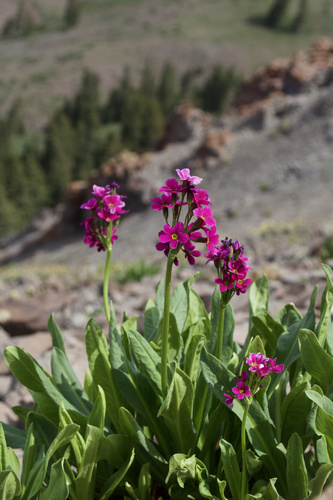
Parry's Primrose (Primula parryi) is one of the most striking and robust wildflowers of the North American alpine zone. Thriving in the harsh, cold environments of the Rocky Mountains and adjacent ranges, this perennial plant stands out with its brilliant clusters of magenta flowers. It is often found hugging the edges of cold mountain streams, subalpine meadows, and melting snowbanks, where it enjoys a constant supply of icy water. What makes Parry's Primrose particularly fascinating is its sheer resilience. It blooms during the short alpine summer, transforming desolate rocky landscapes into vibrant displays of color. However, hikers who lean in for a sniff might be surprised; unlike many sweet-smelling primroses, this species emits a strong, musky, and sometimes disagreeable odor. This pungent scent is an evolutionary strategy designed to attract specific high-altitude pollinators like flies and bees when resources are scarce.
Hábitat: Typically found in wet subalpine and alpine environments, growing along the edges of cold mountain streams, wet ledges, snowbanks, and boggy meadows at high elevations.
This robust herbaceous perennial grows between 15 and 50 centimeters tall, arising from a thick, fleshy basal rosette of lance-shaped, dark green leaves. The leaves are somewhat sticky and can reach up to 25 centimeters in length. Rising above the foliage is a stout, upright stem that bears a showy, one-sided cluster of 5 to 25 flowers. Each flower is vivid pinkish-purple to magenta, measuring about 2 to 3 centimeters across, with a distinct, bright yellow eye at its center.
Categoría
PlantasRareza
Common
Peligro
1/5 · Muy bajo
Snaps
¡Sé la primera persona en hacer un snap!
Despite being a primrose, its scent is often described as resembling carrion or wet dog, a deliberate adaptation to attract flies as pollinators.
It is named after Charles Christopher Parry, a 19th-century botanist who extensively cataloged the flora of the Rocky Mountains.
This plant is a true snow-lover, often blooming directly through retreating snowbanks where its roots are constantly bathed in freezing water.
Utilizes specialized solutes and protective proteins within its cell sap to withstand sudden freezing temperatures without experiencing cellular damage.
Produces a strong, pungent aroma that carries well in thin mountain air, drawing in flies and bees that are essential for high-altitude pollination.
Features a root system highly adapted to tolerate waterlogged, cold, and anaerobic conditions, allowing it to grow directly in glacial runoff pathways.
As a photosynthetic plant, Parry's Primrose produces its own sugars using sunlight, carbon dioxide, and water, supplemented by minerals absorbed through its root system.
Bombus balteatus
Pollinated by this high-altitude bumblebee species which is attracted to its bright magenta petals.
Marmota flaviventris
Occasionally grazed on by this alpine mammal in subalpine meadows.
Syrphus opinator
Attracted by the plant's strong odor, these flies assist in cross-pollination.
Aún no hay insignias de rasgos asignadas a este objeto.
Todavía no hay alias listados.
Las colecciones para este objeto aparecerán aquí a medida que se añadan más temas.
Peligro
1/5 · Muy bajo
Todavía no hay notas especiales de seguridad.
La forma más fácil de identificar a Parry'S Primrose es usar la aplicación de identificación de naturaleza Snappit.
15-50 cm
0.02-0.15 kg
5-15 años
As a photosynthetic plant, Parry's Primrose produces its own sugars using sunlight, carbon dioxide, and water, supplemented by minerals absorbed through its root system.
Typically found in wet subalpine and alpine environments, growing along the edges of cold mountain streams, wet ledges, snowbanks, and boggy meadows at high elevations.
Acércate para separar los grupos y explorar dónde se ha fotografiado este objeto.
Los snaps recientes aparecerán aquí a medida que se añadan nuevas observaciones.















