

Peruvian Spikemoss
selaginella peruviana
The Peruvian Spikemoss (Selaginella peruviana) is a fascinating member of the ancient clubmoss family, a lineage of vascular plants that predate flowering plants and conifers. Often found carpeting the forest floor or clinging to rocks in its native Andean habitats, this small plant offers a glimpse into Earth's primordial flora. It's not a true moss, despite its common name, but rather a lycophyte, a group characterized by their unique microphylls and reproduction via spores. Its resilience and ability to thrive in specific microclimates make it an intriguing subject for botanists and nature enthusiasts alike, embodying the enduring success of early land plants.
Hábitat: Found in humid, shady understory environments of montane forests, often growing on rocky substrates, decaying wood, or moist soil banks in the Andes.
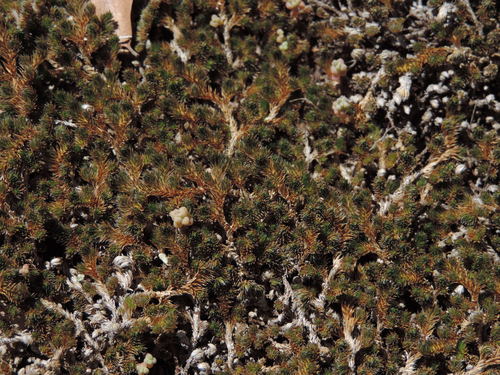
Selaginella peruviana typically forms low-growing, mat-like colonies, spreading across its substrate with delicate, branching stems. Its leaves, known as microphylls, are small and scale-like, often overlapping, and arranged spirally or in distinct rows along the stem, giving it a somewhat flattened, feathery or fern-like appearance. The coloration is usually a vibrant green, though it can sometimes show reddish or bronzed tints, particularly when exposed to stronger light or during environmental stress. It lacks flowers and instead produces small, cone-like structures called strobili, which contain its spores, often at the tips of its branches.
Categoría
PlantasRareza
Common
Peligro
1/5 · Muy bajo
Snaps
¡Sé la primera persona en hacer un snap!
Many species of Selaginella exhibit 'resurrection plant' capabilities, where they can dry out completely and appear lifeless during drought, only to unfurl and regain their green color when moisture returns.
Spikemosses, including the Peruvian Spikemoss, belong to the ancient group of lycophytes, which are among the oldest surviving lineages of vascular plants, with ancestors dating back over 400 million years.
The genus Selaginella is notable for being heterosporous, meaning it produces two different types of spores: larger megaspores (female) and smaller microspores (male), a key evolutionary step towards seed production.
Unlike true mosses, spikemosses possess vascular tissue (xylem and phloem), allowing them to transport water and nutrients more efficiently and grow larger, though Selaginella peruviana remains relatively small.
Many spikemosses can withstand periods of extreme drying, shriveling up and appearing dead, only to revive and rehydrate once moisture returns.
Possesses unique microphylls, small, simple leaves with a single unbranched vein, which are highly efficient at capturing sunlight in shaded understories.
Reproduces through microscopic spores released from specialized cone-like structures (strobili), allowing for dispersal by wind and colonization of new, moist habitats.
As a photosynthetic organism, Peruvian Spikemoss produces its own food through the process of photosynthesis, converting sunlight, water, and carbon dioxide into sugars for energy. It absorbs essential minerals and nutrients from the soil or substrate it grows upon.
Various fungal species
Forms part of the understory vegetation, providing microhabitat and ground cover.
Collembola species
Provides ground cover and microhabitat.
Bryophyte species
Grows alongside other moisture-loving plants.
Various bacterial and archaeal species
Contributes to soil stability and nutrient cycling.
Aún no hay insignias de rasgos asignadas a este objeto.
Todavía no hay alias listados.
Las colecciones para este objeto aparecerán aquí a medida que se añadan más temas.
Peligro
1/5 · Muy bajo
Todavía no hay notas especiales de seguridad.
La forma más fácil de identificar a Peruvian Spikemoss es usar la aplicación de identificación de naturaleza Snappit.
5-20 cm
0.001-0.01 kg
3-10 años
As a photosynthetic organism, Peruvian Spikemoss produces its own food through the process of photosynthesis, converting sunlight, water, and carbon dioxide into sugars for energy. It absorbs essential minerals and nutrients from the soil or substrate it grows upon.
Found in humid, shady understory environments of montane forests, often growing on rocky substrates, decaying wood, or moist soil banks in the Andes.
Photosynthesis/nutrient Absorption
Acércate para separar los grupos y explorar dónde se ha fotografiado este objeto.
Los snaps recientes aparecerán aquí a medida que se añadan nuevas observaciones.








