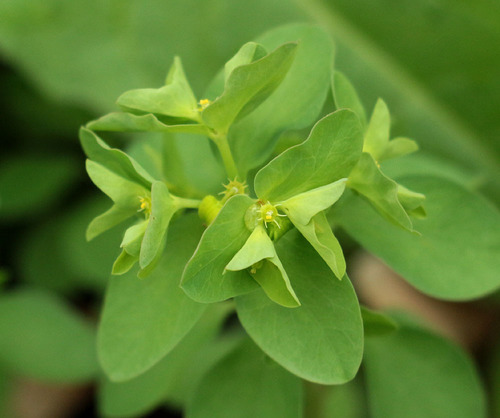


Petty Spurge
euphorbia peplus
Petty Spurge (Euphorbia peplus), also widely known as radium weed, is a small, fast-growing annual plant native to Europe, North Africa, and Western Asia, but now widely naturalized across the globe. Despite its unassuming, weed-like appearance, this plant holds significant ecological and medical interest. It thrives in disturbed soils, gardens, and urban sidewalk cracks, effortlessly establishing itself where other plants struggle to grow. Historically used in traditional folk medicine, its toxic, milky white sap contains a compound called ingenol mebutate, which has been scientifically studied and approved for treating precancerous skin conditions like actinic keratosis.
Hábitat: Commonly found in nutrient-rich disturbed soils, domestic gardens, cultivated fields, waste ground, and pavement cracks in urban environments.
This delicate annual herb grows between 5 to 30 cm tall, featuring smooth, hairless, bright green to slightly reddish-tinged stems. Its leaves are alternate, oval-shaped, and short-petioled, measuring up to 2 cm in length. The plant is easily recognized by its distinctive umbrella-like branching pattern at the top, which supports tiny, pale green flowers (cyathia) surrounded by crescent-shaped glands with sharp 'horns'. When any part of the stem or leaf is broken, it immediately exudes a thick, sticky, milky-white latex sap.
Categoría
PlantasRareza
Common
Peligro
1/5 · Muy bajo
Snaps
¡Sé la primera persona en hacer un snap!
Petty Spurge seeds can lie dormant in the soil for several years, waiting for the ground to be disturbed before germinating.
The chemical compound ingenol mebutate, isolated from this plant's sap, was approved by the FDA in 2012 as a gel treatment for precancerous skin lesions.
The plant's popular nickname 'Radium Weed' refers to its historical use as a home remedy for burning off sunspots and warts, similar to radiation treatments.
Produces a toxic, caustic milky sap that deters herbivores and protects damaged tissue from bacterial and fungal pathogens.
Utilizes explosive seed capsules that split violently when dry, catapulting seeds several feet away from the parent plant.
Seeds have a specialized lipid-rich appendage called an elaiosome that coaxes ants into carrying them safely underground.
As a photosynthetic plant, Petty Spurge synthesizes its own organic compounds using sunlight, water, carbon dioxide, and essential soil nutrients.
Hyles euphorbiae
Caterpillars of this moth feed on the toxic leaves, sequestering the plant's toxins to defend themselves against predators.
Linepithema humile
Ants collect the seeds to feed on the nutritious elaiosome, inadvertently planting them safely underground.
Apis mellifera
Honey bees occasionally visit the tiny flowers for nectar, acting as minor pollinators.
Aún no hay insignias de rasgos asignadas a este objeto.
Todavía no hay alias listados.
Las colecciones para este objeto aparecerán aquí a medida que se añadan más temas.
Peligro
1/5 · Muy bajo
Todavía no hay notas especiales de seguridad.
La forma más fácil de identificar a Petty Spurge es usar la aplicación de identificación de naturaleza Snappit.
5-30 cm
0.005-0.05 kg
0-1 años
As a photosynthetic plant, Petty Spurge synthesizes its own organic compounds using sunlight, water, carbon dioxide, and essential soil nutrients.
Commonly found in nutrient-rich disturbed soils, domestic gardens, cultivated fields, waste ground, and pavement cracks in urban environments.
Photosynthesis
Acércate para separar los grupos y explorar dónde se ha fotografiado este objeto.
Los snaps recientes aparecerán aquí a medida que se añadan nuevas observaciones.
















