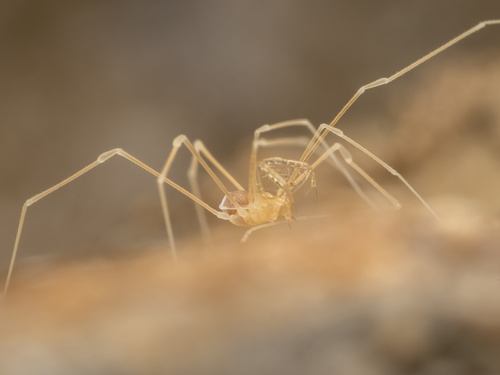


Phalangodes Armata
phalangodes armata
El Phalangodes armata, también conocido simplemente como segador de cueva, es un arácnido fascinante y altamente especializado, adaptado a la vida en la oscuridad perpetua de los ecosistemas subterráneos. Encontrado principalmente en los sistemas de cuevas de piedra caliza del sureste de los Estados Unidos, esta delicada criatura muestra el increíble poder de la adaptación evolutiva. A diferencia de sus primos que viven en la superficie, estos segadores han cambiado la vista aguda por sentidos táctiles y químicos altamente desarrollados para navegar por sus escarpados y oscuros hogares. Observar al Phalangodes armata es un deleite para cualquier espeleólogo o entusiasta de lo subterráneo. Estos arácnidos juegan un papel vital en la ecología de las cuevas, actuando tanto como depredadores de microinvertebrados como carroñeros de detritos orgánicos. Su presencia es un indicador clave de un ecosistema de cueva saludable y funcional, destacando el delicado equilibrio de la vida subterránea.
Hábitat: Se encuentra típicamente en las zonas oscuras de cuevas de piedra caliza, aferrándose a paredes húmedas, techos o bajo materia orgánica en descomposición.
Este diminuto arácnido tiene un cuerpo compacto y ovalado que mide solo de 1.5 a 3 milímetros de largo, con una coloración pálida amarillenta, ámbar o translúcida que carece de pigmentación oscura protectora. Presenta patas extremadamente largas y filiformes, con el segundo par notablemente alargado para servir como antenas sensoriales. Sus pedipalpos están fuertemente armados con espinas afiladas y conspicuas utilizadas para agarrar presas, y sus ojos están muy reducidos, apareciendo como pequeños puntos oscuros no funcionales en su cabeza.
Categoría
InvertebrateRareza
Común
Peligro
1/5 · Muy bajo
Snaps
¡Sé la primera persona en hacer un snap!
Tiene ojos muy reducidos debido a su adaptación evolutiva a la vida en sistemas de cuevas oscuras, dependiendo casi por completo de los sentidos táctiles y químicos.
Su segundo par de patas es el doble de largo que su cuerpo y actúa casi exactamente como las antenas de un insecto.
A diferencia de las arañas verdaderas, Phalangodes armata no produce seda ni teje telarañas, dependiendo en su lugar de la búsqueda activa de alimento y el rastreo.
Usa su extremadamente largo segundo par de patas como sensores táctiles y químicos para navegar y localizar presas en completa oscuridad.
Posee una tasa metabólica increíblemente lenta, lo que le permite sobrevivir largos períodos en ambientes de cuevas con escasez de alimentos.
Emite una secreción química punzante de glándulas odoríferas defensivas para disuadir a posibles depredadores de las cuevas.
Se alimenta oportunistamente de pequeños invertebrados que habitan en cuevas, esporas de hongos y detritos orgánicos encontrados en ecosistemas subterráneos.
Neaphaenops tellkampfii
Compite por pequeñas presas como colémbolos en cámaras profundas de cuevas.
Pseudotriton ruber
Depreda a los segadores de cueva que deambulan cerca de las entradas de las cuevas o zonas crepusculares.
Sinella cavernarum
Sirve como una presa principal para el segador de cueva.
Aún no hay insignias de rasgos asignadas a este objeto.
Todavía no hay alias listados.
Las colecciones para este objeto aparecerán aquí a medida que se añadan más temas.
Peligro
1/5 · Muy bajo
Todavía no hay notas especiales de seguridad.
Compara la simetría del cuerpo, las conchas, los segmentos, las patas, los tentáculos y la forma de moverse del animal. Los invertebrados abarcan muchos grupos sin relación entre sí, así que empieza por la estructura del cuerpo. Identificador de invertebrados: sube una foto y compara los detalles visibles.
0 cm
0.00001-0.00005 kg
1-3 años
Se alimenta oportunistamente de pequeños invertebrados que habitan en cuevas, esporas de hongos y detritos orgánicos encontrados en ecosistemas subterráneos.
Se encuentra típicamente en las zonas oscuras de cuevas de piedra caliza, aferrándose a paredes húmedas, techos o bajo materia orgánica en descomposición.
Búsqueda De Alimento
10-40
Acércate para separar los grupos y explorar dónde se ha fotografiado este objeto.
Los snaps recientes aparecerán aquí a medida que se añadan nuevas observaciones.
Llévate el descubrimiento
Haz una foto con Snappit, identifica la especie y guarda el hallazgo en tu colección.