


Pilo
coprosma montana
El Pilo, conocido científicamente como Coprosma montana, es un arbusto nativo resistente e integral que se encuentra en las regiones alpinas y subalpinas de Nueva Zelanda. Esta planta robusta desempeña un papel ecológico crucial en su entorno hostil, a menudo formando densos matorrales que brindan refugio y estabilidad a delicados ecosistemas montañosos. Su adaptabilidad a condiciones extremas, desde fuertes vientos hasta intensa radiación UV y bajas temperaturas, lo convierte en un fascinante ejemplo de éxito evolutivo en hábitats desafiantes. El Pilo contribuye significativamente a la biodiversidad al ofrecer recursos alimenticios a aves e invertebrados nativos, destacando su importancia en la intrincada red de la vida montañesa.
Hábitat: Se encuentra predominantemente en matorrales subalpinos y alpinos, afloramientos rocosos y bosques montanos, a menudo en ambientes expuestos y de gran altitud.
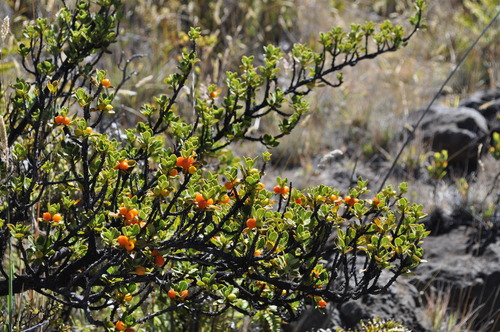
El Pilo se presenta típicamente como un arbusto de tamaño pequeño a mediano, a menudo formando masas densas y enredadas. Sus hojas son pequeñas, gruesas y coriáceas, una adaptación para reducir la pérdida de agua y soportar condiciones adversas. Generalmente son de color verde oscuro, a menudo con una superficie brillante, y pueden aparecer algo bronceadas en áreas expuestas. La planta es dioica, con flores verdes discretas que maduran en pequeñas drupas (bayas) carnosas de color rojo o naranja que son visualmente llamativas contra el follaje cuando están maduras. Las ramas son rígidas y a menudo se entrelazan, contribuyendo a su apariencia compacta y robusta.
Categoría
PlantasRareza
Común
Peligro
1/5 · Muy bajo
Snaps
¡Sé la primera persona en hacer un snap!
Como muchas plantas nativas de Nueva Zelanda, Coprosma montana tiene flores pequeñas, verdes e inconspicuas que son polinizadas por el viento o por pequeños insectos nativos.
El nombre 'Coprosma' proviene del griego 'kopros' (estiércol) y 'osme' (olor), en referencia al desagradable aroma de las hojas trituradas de algunas especies del género.
Las hojas pequeñas y resistentes de Coprosma montana están especialmente adaptadas para soportar la desecación extrema y las temperaturas bajo cero comunes en su hábitat de gran altitud.
Coprosma montana posee adaptaciones robustas, incluyendo hojas pequeñas y coriáceas y una forma de crecimiento compacta, que le permiten prosperar en las duras y expuestas condiciones de los entornos alpinos con fuertes vientos, bajas temperaturas y radiación UV intensa.
Con plantas masculinas y femeninas separadas, el Pilo promueve la exogamia, mejorando la diversidad genética y la resiliencia dentro de sus poblaciones, lo cual es vital para adaptarse a las cambiantes presiones ambientales.
La planta produce pequeñas drupas (frutos) carnosas de color rojo o naranja vibrantes que son muy atractivas para las aves nativas, facilitando una eficiente dispersión de semillas a lo largo de su hábitat montañoso.
Como planta autótrofa, el Pilo genera su propia energía a través de la fotosíntesis, utilizando la luz solar, el dióxido de carbono de la atmósfera y el agua, junto con los nutrientes minerales esenciales absorbidos del suelo.
Prosthemadera novaeseelandiae
Se alimenta de los frutos de la planta, ayudando en la dispersión de semillas.

Cervus elaphus
Se alimenta de las hojas y tallos del arbusto.

Various species
Asociados con el sistema radicular de la planta, mejorando la absorción de nutrientes.
Various species
Poliniza las flores, facilitando la reproducción.
Aún no hay insignias de rasgos asignadas a este objeto.
Todavía no hay alias listados.
Las colecciones para este objeto aparecerán aquí a medida que se añadan más temas.
Peligro
1/5 · Muy bajo
Todavía no hay notas especiales de seguridad.
Empieza por la planta entera y luego compara la disposición de las hojas, sus bordes, los tallos y las flores o frutos, si los hay. Las hojas opuestas crecen en parejas; las alternas salen de una en una a lo largo del tallo. Juntos, estos detalles dicen mucho más que una sola hoja verde. Identificador de plantas: sube una foto y compara los detalles visibles.
50-250 cm
2-20 kg
20-80 años
Como planta autótrofa, el Pilo genera su propia energía a través de la fotosíntesis, utilizando la luz solar, el dióxido de carbono de la atmósfera y el agua, junto con los nutrientes minerales esenciales absorbidos del suelo.
Se encuentra predominantemente en matorrales subalpinos y alpinos, afloramientos rocosos y bosques montanos, a menudo en ambientes expuestos y de gran altitud.
Búsqueda De Alimento
Acércate para separar los grupos y explorar dónde se ha fotografiado este objeto.
Los snaps recientes aparecerán aquí a medida que se añadan nuevas observaciones.
Llévate el descubrimiento
Haz una foto con Snappit, identifica la especie y guarda el hallazgo en tu colección.

















