

Pimelia Ascendens
pimelia ascendens
The Pimelia Ascendens is a fascinating darkling beetle endemic to coastal dunes and arid sandy environments. Renowned for its hardy nature, this flightless insect has perfectly adapted to survive in some of the most challenging, water-scarce landscapes. It plays a critical role in its ecosystem as a recycler, breaking down organic detritus and returning nutrients to the sandy soil. Observing one of these robust beetles laboriously navigating the shifting sands is a true testament to nature's resilience. Their slow, deliberate movements and dome-shaped bodies make them iconic residents of dry coastal ecosystems, where they represent an evolutionary marvel of desert survival.
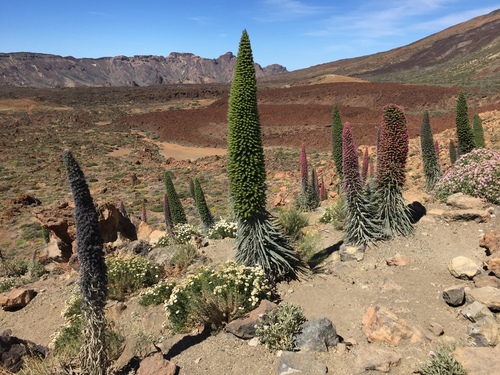
Hábitat: Found in coastal sand dunes and semi-arid scrublands, typically near low-growing halophytic vegetation.
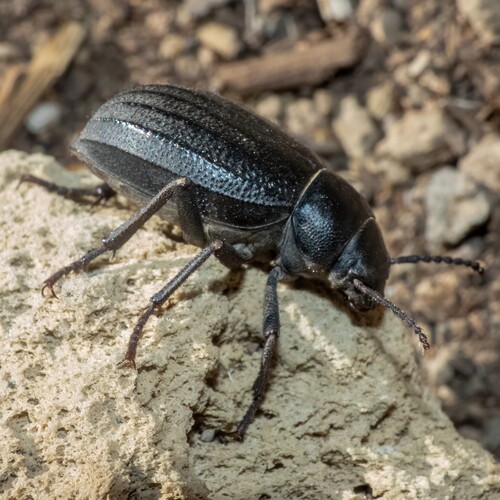
This beetle features a robust, heavily armored, sub-globular body that is entirely matte black or deep charcoal in color. Its fused elytra (wing covers) are distinctly textured with fine ridges, bumps, or granules, which provide structural strength and reduce water loss. Lacking hind wings, it is entirely flightless. It possesses sturdy, jointed legs adapted for walking on loose sand, and reaches an adult length of approximately 1.5 to 2.5 centimeters.
Categoría
InsectosRareza
Common
Peligro
1/5 · Muy bajo
Snaps
¡Sé la primera persona en hacer un snap!
Because they cannot fly, these beetles rely entirely on walking and can travel surprisingly long cumulative distances across shifting dunes in search of food.
Their fused wing covers act like an insulated shield, keeping their delicate internal organs cool against the scorching desert sun.
They play a crucial ecological role as sanitation workers of the dunes, clearing away dead organic matter that would otherwise accumulate.
Their fused elytra create a sealed, humid sub-elytral cavity over their spiracles, drastically reducing water loss in hot, arid climates.
Equipped with strong, fossorial legs, they can rapidly excavate loose sand to bury themselves and escape extreme midday temperatures or predators.
An exceptional sense of chemical detection allows them to locate dry plant matter and organic debris over long distances in barren landscapes.
Primarily feeds on decaying plant material, dry leaves, seeds, and occasionally dead insect remains found on the sand surface.
Diferencias por edad: Larvae live underground and feed predominantly on decaying root matter, whereas adults forage on the surface.
Gallotia galloti
A primary lizard predator that hunts adult beetles on open dunes.
Euphorbia balsamifera
Provides essential shade, microhabitat moisture, and falling leaf litter for food.
Pimelia radula
Competes for foraging resources and shelter in overlapping microhabitats.
Aún no hay insignias de rasgos asignadas a este objeto.
Todavía no hay alias listados.
Las colecciones para este objeto aparecerán aquí a medida que se añadan más temas.
Peligro
1/5 · Muy bajo
Todavía no hay notas especiales de seguridad.
La forma más fácil de identificar a Pimelia Ascendens es usar la aplicación de identificación de naturaleza Snappit.
1-3 cm
0.001-0.003 kg
1-3 años
1 km/h
Primarily feeds on decaying plant material, dry leaves, seeds, and occasionally dead insect remains found on the sand surface.
Found in coastal sand dunes and semi-arid scrublands, typically near low-growing halophytic vegetation.
Foraging
Acércate para separar los grupos y explorar dónde se ha fotografiado este objeto.
Los snaps recientes aparecerán aquí a medida que se añadan nuevas observaciones.