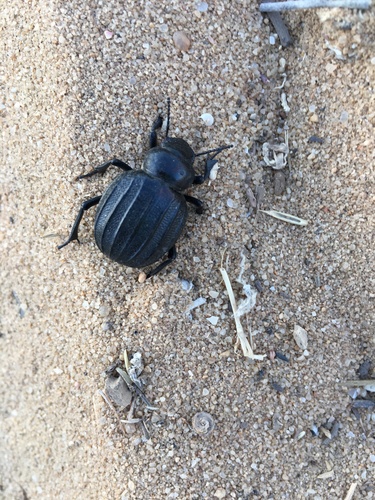


Pimelia costata
pimelia costata
Pimelia costata, también conocida como el escarabajo tenebriónido gigante de Gran Canaria, es un notable insecto áptero endémico de las dunas costeras y los matorrales secos de Gran Canaria. Adaptado para vivir en algunos de los ambientes más áridos de la isla, este robusto escarabajo desempeña un papel ecológico crucial como detritívoro, reciclando la escasa materia orgánica de nuevo en el suelo arenoso. Debido al intenso turismo y al desarrollo urbano que destruyen sus hábitats naturales, este escarabajo único se enfrenta a graves desafíos de conservación y está altamente protegido.
Hábitat: Típicamente se encuentra en dunas de arena costeras, playas arenosas y matorrales xerofíticos de cardonal-tabaibal de Gran Canaria.
Con una longitud de entre 1.8 y 2.5 centímetros, este escarabajo presenta un exoesqueleto robusto, redondeado y de color negro mate. Su característica más distintiva es la serie de crestas longitudinales prominentes y elevadas, o costillas, que recorren sus élitros fusionados. Al ser completamente áptero, carece de alas posteriores funcionales, lo que le da una apariencia pesada y robusta con patas fuertes y gruesas, muy adecuadas para arrastrarse y excavar en las arenas movedizas.
Categoría
InsectosRareza
Común
Peligro
1/5 · Muy bajo
Snaps
¡Sé la primera persona en hacer un snap!
Dado que son completamente ápteros, sus cubiertas alares han evolucionado para actuar como un escudo físico que los protege de la deshidratación.
Son micro-endémicos, lo que significa que son nativos de una sola isla en el mundo y no se pueden encontrar en ningún otro lugar de forma natural.
Cuando se sienten amenazados, a menudo se hacen los muertos rodando sobre sus espaldas e inmovilizando sus patas, un mecanismo de defensa llamado tanatosis.
Utiliza su exoesqueleto rugoso y mate para capturar el rocío matutino y la humedad de la niebla costera, permitiendo que las gotas de agua se deslicen directamente a sus piezas bucales.
Sus élitros están firmemente fusionados para formar una cámara interna sellada, reduciendo drásticamente la pérdida de humedad en temperaturas abrasadoras.
Posee fuertes patas delanteras en forma de pala que le permiten excavar rápidamente bajo la arena suelta para escapar de los depredadores y del calor extremo del mediodía.
Se alimenta de forma oportunista de materia vegetal en descomposición, semillas caídas e insectos muertos que encuentra en el suelo.
Diferencias por edad: Las larvas viven bajo tierra alimentándose de raíces en descomposición, mientras que los adultos buscan alimento en la superficie.
Gallotia stehlini
Depredado por esta gran especie de lagarto endémico de Gran Canaria.
Euphorbia canariensis
Consume hojarasca en descomposición y restos caídos de esta euforbia endémica.
Aún no hay insignias de rasgos asignadas a este objeto.
Todavía no hay alias listados.
Las colecciones para este objeto aparecerán aquí a medida que se añadan más temas.
Peligro
1/5 · Muy bajo
Todavía no hay notas especiales de seguridad.
Busca élitros duros que se juntan en una línea por el lomo y compara después las antenas, la forma del cuerpo, las patas y las marcas. Los colores metálicos cambian mucho con la luz. Identificador de escarabajos: sube una foto y compara los detalles visibles.
1-2 cm
0.001-0.003 kg
1-3 años
1 km/h
Se alimenta de forma oportunista de materia vegetal en descomposición, semillas caídas e insectos muertos que encuentra en el suelo.
Típicamente se encuentra en dunas de arena costeras, playas arenosas y matorrales xerofíticos de cardonal-tabaibal de Gran Canaria.
Búsqueda De Alimento
Acércate para separar los grupos y explorar dónde se ha fotografiado este objeto.
Los snaps recientes aparecerán aquí a medida que se añadan nuevas observaciones.
Llévate el descubrimiento
Haz una foto con Snappit, identifica la especie y guarda el hallazgo en tu colección.