

Pine Barren Frostweed
crocanthemum corymbosum
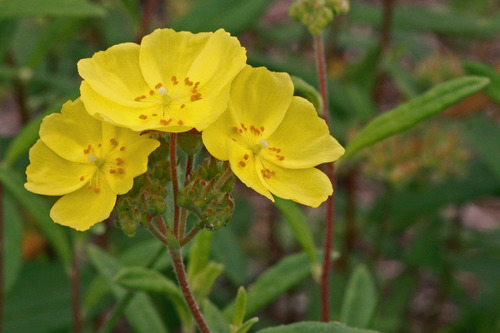
Pine Barren Frostweed (Crocanthemum corymbosum) is a resilient perennial wildflower native to the sandy coastal plains and pine barrens of the southeastern United States. Thriving in nutrient-poor environments, this hardy species brightens open sandy habitats with its yellow flowers. It belongs to the rockrose family, which is highly adapted to fire-prone ecosystems. What makes this plant particularly captivating is its ability to produce delicate, ribbon-like ice crystals from its stems during early winter freezes, hence the name 'frostweed'. Throughout the spring and summer, it acts as a valuable food source for various native insect pollinators.
Hábitat: Typically found in well-drained, sandy soils of pine flatwoods, coastal scrub, sandhills, and maritime forests of the southeastern United States.
Growing between 15 and 50 cm tall, this perennial plant features erect, woody-based stems clad in fine, star-shaped hairs that give it a slightly dusty, grayish-green appearance. The leaves are simple, alternate, and lanceolate to elliptic. In late spring, it produces clusters of bright yellow flowers, each featuring five delicate, paper-like petals surrounding a central cluster of many golden-yellow stamens. It also bears smaller, petal-less, self-pollinating flowers closer to the ground.
Categoría
PlantasRareza
Common
Peligro
1/5 · Muy bajo
Snaps
¡Sé la primera persona en hacer un snap!
It belongs to the rockrose family, Cistaceae, which is renowned for species that thrive in harsh, rocky, or sandy disturbances.
The dramatic ice ribbons it produces are caused by capillary action, drawing water up from the roots to freeze at the stem base.
The plant's showy flowers only open for a single day, relying on rapid visitation by insect pollinators before shedding their petals.
On freezing winter mornings, sap is forced out of fissures in the lower stem, freezing instantly into intricate, ribbon-like ice sculptures.
The plant produces closed, self-pollinating flowers near the ground as a reproductive backup system in case open flowers are not pollinated.
It possesses a woody base and deep root system that allow it to quickly resprout and thrive following seasonal wildfires.
As a photoautotrophic plant, it manufactures its own energy from sunlight, water, and carbon dioxide through photosynthesis.
Lasioglossum pectorale
Native bees visit the showy yellow flowers to collect pollen and nectar, assisting in cross-pollination.
Gopherus polyphemus
Gopher tortoises forage on the low-growing foliage and stems of the plant in sandy upland habitats.
Aristida stricta
It competes for space, sunlight, and soil moisture with dominant groundcover plants in pine barrens.
Aún no hay insignias de rasgos asignadas a este objeto.
Todavía no hay alias listados.
Las colecciones para este objeto aparecerán aquí a medida que se añadan más temas.
Peligro
1/5 · Muy bajo
Todavía no hay notas especiales de seguridad.
La forma más fácil de identificar a Pine Barren Frostweed es usar la aplicación de identificación de naturaleza Snappit.
15-50 cm
3-10 años
As a photoautotrophic plant, it manufactures its own energy from sunlight, water, and carbon dioxide through photosynthesis.
Typically found in well-drained, sandy soils of pine flatwoods, coastal scrub, sandhills, and maritime forests of the southeastern United States.
Acércate para separar los grupos y explorar dónde se ha fotografiado este objeto.
Los snaps recientes aparecerán aquí a medida que se añadan nuevas observaciones.















