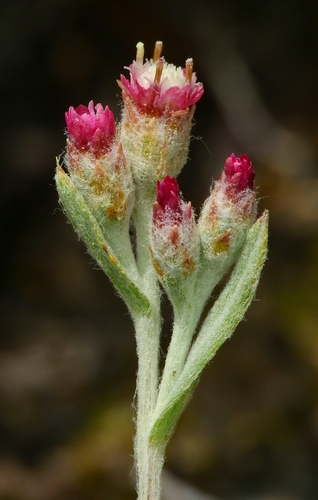


Pinewoods Pussytoes
antennaria geyeri
Pinewoods Pussytoes (Antennaria geyeri) is a charming perennial herb native to the dry pine forests and open, sandy woodlands of western North America. Unlike many of its close relatives in the pussytoes genus that form low, sprawling mats, this species grows in distinct upright stems from a sturdy woody base. It is highly adapted to nutrient-poor soils and arid conditions, relying on its dense, woolly coat to survive intense sunlight and minimize moisture loss.
Hábitat: Found in dry, open pine forests, particularly ponderosa and lodgepole pine woodlands, often growing in sandy or volcanic soils.
This upright perennial typically reaches heights of 5 to 20 centimeters, featuring erect, unbranched stems. The entire plant is covered in a dense layer of white, cobwebby or woolly hairs, giving it a soft, grayish-green appearance. Its leaves are narrow, spoon-shaped to linear, and alternate along the stems. The flowering heads are small, tight clusters resembling a kitten's paw, with white to pale pinkish disc florets surrounded by dry, papery, brownish-tipped bracts.
Categoría
PlantasRareza
Common
Peligro
1/5 · Muy bajo
Snaps
¡Sé la primera persona en hacer un snap!
Its dense, woolly fibers were historically used by indigenous peoples and early settlers as a soft tinder for starting campfires.
The common name 'pussytoes' comes from the shape of the flower heads, which closely resemble the soft, velvety pads of a kitten's paw.
Unlike many other members of the Antennaria genus, Pinewoods Pussytoes does not produce runners (stolons) and instead grows as a solitary, upright clump.
The dense coating of white, woolly hairs reflects excess solar radiation and traps moisture close to the plant tissue, reducing transpiration.
A woody caudex and deep taproot allow the plant to anchor securely in loose, sandy soils and access moisture deep below the surface.
Its woody base enables it to survive low-intensity ground fires common in its pine-forest habitat, regenerating quickly from the underground caudex.
As an autotrophic plant, it produces its own energy through photosynthesis, utilizing sunlight, carbon dioxide, and water while absorbing essential soil minerals.
Vanessa cardui
Larvae of the Painted Lady butterfly feed on the woolly foliage of pussytoes species.
Halictus ligatus
Native sweat bees visit the flowers to gather pollen and nectar, facilitating pollination.
Odocoileus hemionus
Mule deer occasionally forage on the dry foliage during the lean seasons, though it is not a primary food source.
Aún no hay insignias de rasgos asignadas a este objeto.
Todavía no hay alias listados.
Las colecciones para este objeto aparecerán aquí a medida que se añadan más temas.
Peligro
1/5 · Muy bajo
Todavía no hay notas especiales de seguridad.
La forma más fácil de identificar a Pinewoods Pussytoes es usar la aplicación de identificación de naturaleza Snappit.
5-20 cm
3-10 años
As an autotrophic plant, it produces its own energy through photosynthesis, utilizing sunlight, carbon dioxide, and water while absorbing essential soil minerals.
Found in dry, open pine forests, particularly ponderosa and lodgepole pine woodlands, often growing in sandy or volcanic soils.
Acércate para separar los grupos y explorar dónde se ha fotografiado este objeto.
Los snaps recientes aparecerán aquí a medida que se añadan nuevas observaciones.