

Pink Knotweed
persicaria capitata
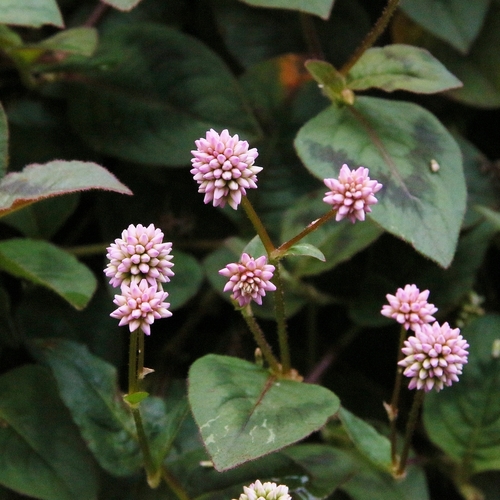
Pink Knotweed, scientifically known as Persicaria capitata, is a vibrant and hardy perennial ground cover that effortlessly weaves a dense carpet of green and burgundy. Native to the mountainous regions of Asia, specifically the Himalayas, it has become a popular ornamental plant worldwide due to its low-growing, mat-forming habit and charming spherical pink flower heads that bloom abundantly from spring through fall. Beyond its ornamental appeal, this tenacious plant is known for its ability to thrive in challenging conditions, quickly colonizing rocky crevices, walls, and disturbed soils. While it adds a splash of rosy color to hanging baskets and garden borders, its vigorous creeping nature means it often escapes cultivation. In many mild and coastal climates globally, it has earned a reputation as a resilient, opportunistic weed. Despite its sometimes aggressive spread, it remains a favorite for rock gardens and urban landscapes where few other plants can survive the compacted soils and heat.
Hábitat: Found in rocky outcrops, disturbed soils, cracks in pavement, and garden edges, often thriving in mild, moist to dry environments.
This low-growing, trailing herbaceous plant rarely exceeds 15 cm in height but can spread extensively to form a dense mat. Its oval-shaped leaves are an attractive mid-green, easily distinguished by a striking, V-shaped or chevron-like dark burgundy band across the center. The wiry stems are often tinged with red and root at the nodes as they creep along the ground. From spring to autumn, it produces distinctive, densely packed, globe-shaped flower heads that are a bright bubblegum pink, held slightly above the foliage on slender, delicate stalks.
Categoría
PlantasRareza
Common
Peligro
1/5 · Muy bajo
Snaps
¡Sé la primera persona en hacer un snap!
Despite its delicate appearance, Pink Knotweed is remarkably strong and can push its way through solid asphalt and concrete cracks.
In traditional medicine systems of its native Himalayan region, extracts from the plant have been historically used to treat urinary tract and kidney issues.
Its scientific name, 'capitata', comes from the Latin word for 'head', perfectly describing its spherical, head-like flower clusters.
The distinctive dark V-shape on its leaves acts somewhat like built-in sunscreen, containing anthocyanins that help protect the plant from harsh sunlight.
Its creeping stems can sprout roots wherever their nodes touch the soil, allowing the plant to rapidly spread and anchor itself to form dense mats.
Once established, it can survive periods of low water availability by storing moisture in its resilient, woody base and wiry stems.
The plant produces an abundance of tiny seeds that are easily dispersed by wind, water, or passing animals, aiding in its opportunistic colonization.
Like all green plants, Pink Knotweed produces its own energy through photosynthesis, utilizing sunlight, water, and carbon dioxide.
Apis mellifera
Visits the pink flower heads to forage for nectar and pollen, aiding in pollination.
Cornu aspersum
Feeds on the tender leaves and stems, especially in moist garden environments.
Ranunculus repens
Competes for ground space and soil nutrients in similar moist, disturbed habitats.
Aún no hay insignias de rasgos asignadas a este objeto.
Todavía no hay alias listados.
Las colecciones para este objeto aparecerán aquí a medida que se añadan más temas.
Peligro
1/5 · Muy bajo
Todavía no hay notas especiales de seguridad.
La forma más fácil de identificar a Pink Knotweed es usar la aplicación de identificación de naturaleza Snappit.
5-15 cm
2-5 años
Like all green plants, Pink Knotweed produces its own energy through photosynthesis, utilizing sunlight, water, and carbon dioxide.
Found in rocky outcrops, disturbed soils, cracks in pavement, and garden edges, often thriving in mild, moist to dry environments.
Acércate para separar los grupos y explorar dónde se ha fotografiado este objeto.
Los snaps recientes aparecerán aquí a medida que se añadan nuevas observaciones.













_Lin._Erbario_Frizzi_Perugia_n._2126.jpg&width=800)