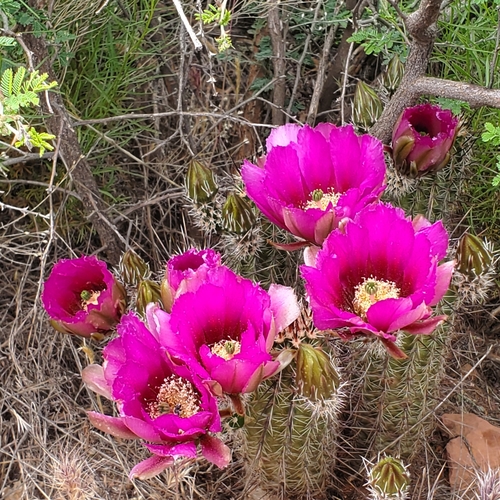


Pinkflower Hedgehog Cactus
echinocereus engelmannii fasciculatus
The Pinkflower Hedgehog Cactus, a subspecies of the widely recognized Engelmann's hedgehog cactus, is a resilient succulent native to the arid expanses of the Southwestern United States and northern Mexico. Growing in multi-stemmed clumps that resemble a sleeping hedgehog, this plant is renowned for its striking, large magenta flowers that bloom in spring. It has adapted beautifully to survive the extreme temperatures of desert environments, making it a critical player in its native ecosystem.
Hábitat: Typically found on gravelly desert slopes, sandy washes, and rocky hillsides within the Sonoran and Mojave Deserts.
This cactus features cylindrical, upright stems reaching 15 to 45 centimeters in height, forming dense, spiny clusters of up to 30 or more stems. The stems are heavily armored with stout, straight spines ranging in color from yellowish-tan to dark brown, which grow in star-shaped clusters. In spring, it produces magnificent funnel-shaped flowers that are bright pink to deep magenta, featuring vibrant green stigmas in their center. Following pollination, it develops egg-shaped, spiny green fruits that turn bright red and lose their spines as they ripen.
Categoría
PlantasRareza
Common
Peligro
1/5 · Muy bajo
Snaps
¡Sé la primera persona en hacer un snap!
Indigenous peoples of the Southwest, such as the Tohono O'odham, historically harvested the sweet fruits as an important seasonal food source.
The common name 'Strawberry Cactus' comes from its delicious red fruits, which are said to taste remarkably like strawberries.
The plant's dense spines are so effective at reflecting heat that the internal temperature of the stem can be several degrees cooler than the surrounding desert air.
Utilizes CAM photosynthesis to open its stomata only at night, significantly reducing water loss through transpiration under the harsh desert sun.
The dense lattice of spines shades the plant's surface, lowering its temperature and breaking up drying winds.
Features a vast, shallow root system that rapidly absorbs rainfall from brief desert storms before the water evaporates.
As a photosynthetic plant, it produces its own organic nutrients using sunlight, carbon dioxide, water, and minerals absorbed from the soil.
Apis mellifera
The flowers are visited and pollinated by bees seeking nectar and pollen.
Dipodomys merriami
Feeds on the sweet, ripe red fruits and helps disperse the seeds across the desert.
Narnia femorata
Feeds on the juices of the cactus stems and fruits, occasionally causing tissue damage.
Aún no hay insignias de rasgos asignadas a este objeto.
Las colecciones para este objeto aparecerán aquí a medida que se añadan más temas.
Peligro
1/5 · Muy bajo
Todavía no hay notas especiales de seguridad.
La forma más fácil de identificar a Pinkflower Hedgehog Cactus es usar la aplicación de identificación de naturaleza Snappit.
15-45 cm
0.5-5 kg
20-50 años
As a photosynthetic plant, it produces its own organic nutrients using sunlight, carbon dioxide, water, and minerals absorbed from the soil.
Typically found on gravelly desert slopes, sandy washes, and rocky hillsides within the Sonoran and Mojave Deserts.
Acércate para separar los grupos y explorar dónde se ha fotografiado este objeto.
Los snaps recientes aparecerán aquí a medida que se añadan nuevas observaciones.














