

Pinkfringe
arthrostemma ciliatum
Pinkfringe, scientifically known as Arthrostemma ciliatum, is a striking herbaceous perennial belonging to the Melastomataceae family, renowned for its vibrant and intricate flowers. This tropical plant, native to Central and South America, often grows as a sprawling or climbing vine, adding a splash of color to forest understories and disturbed areas. Its beauty makes it a favored ornamental in some regions, though it can also naturalize vigorously. It plays a role in its native ecosystem, providing nectar for specialized pollinators and its seeds for dispersal, contributing to the biodiversity of its humid habitats.
Hábitat: This species thrives in moist, tropical to subtropical environments, commonly found in forest edges, clearings, stream banks, and disturbed areas where it can receive adequate sunlight.
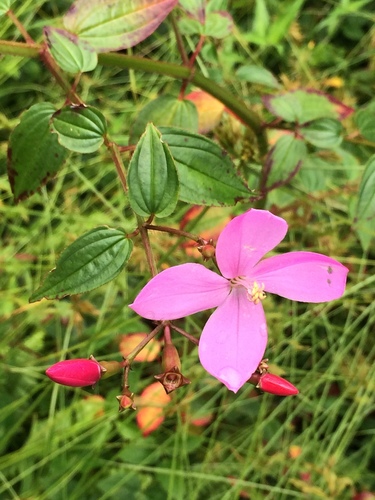
The Pinkfringe is characterized by its slender, often reddish stems that can sprawl along the ground or climb on other vegetation. Its oval to lance-shaped leaves are arranged oppositely and frequently feature fine, bristly hairs (cilia) along their margins, a key identifier. The most captivating feature is its showy flowers, typically bright pink to purplish, measuring approximately 2-3 cm across. Each flower has five delicate petals and prominent, often curved, yellow stamens that create a distinctive 'fringe-like' appearance, giving the plant its common name.
Categoría
PlantasRareza
Common
Peligro
1/5 · Muy bajo
Snaps
¡Sé la primera persona en hacer un snap!
Despite its delicate appearance, Pinkfringe is a robust grower and can quickly form dense patches, especially in moist, well-lit environments.
Its vibrant pink-purple flowers are a common sight in roadside ditches and forest clearings throughout its native tropical range, sometimes even being considered a weed in disturbed agricultural areas.
The distinctive yellow anthers of the Pinkfringe flowers are arranged in a way that requires specific "buzz pollination" (sonication) by certain bee species to release pollen effectively.
The genus name "Arthrostemma" comes from Greek words meaning "jointed crown," referring to the articulated stamens, while "ciliatum" refers to the fringed (ciliate) margins of its leaves.
The unique anthers of Pinkfringe require specific vibrational frequencies (buzz pollination or sonication) from bees to release their pollen, ensuring efficient and specialized pollination.
It possesses a vigorous growth habit and readily colonizes disturbed sites and forest margins, thanks to its ability to root along stems and produce numerous seeds.
Its showy pink-purple flowers and lush foliage make it a popular choice for tropical gardens and hanging baskets, highlighting its aesthetic value.
As a photosynthetic plant, Pinkfringe produces its own food by converting light energy, water, and carbon dioxide into sugars. It absorbs essential minerals from the soil through its root system.
Xylocopa spp.
Pollination mechanism.
(various species)
Seed dispersal.
Atta spp.
Herbivory on foliage.
(various species)
Symbiotic root association.
Aún no hay insignias de rasgos asignadas a este objeto.
Todavía no hay alias listados.
Las colecciones para este objeto aparecerán aquí a medida que se añadan más temas.
Peligro
1/5 · Muy bajo
Todavía no hay notas especiales de seguridad.
La forma más fácil de identificar a Pinkfringe es usar la aplicación de identificación de naturaleza Snappit.
30-200 cm
0.1-1.5 kg
3-10 años
As a photosynthetic plant, Pinkfringe produces its own food by converting light energy, water, and carbon dioxide into sugars. It absorbs essential minerals from the soil through its root system.
This species thrives in moist, tropical to subtropical environments, commonly found in forest edges, clearings, stream banks, and disturbed areas where it can receive adequate sunlight.
Photosynthesis
500-5000
Acércate para separar los grupos y explorar dónde se ha fotografiado este objeto.
Los snaps recientes aparecerán aquí a medida que se añadan nuevas observaciones.