

Plantago Webbii
plantago webbii
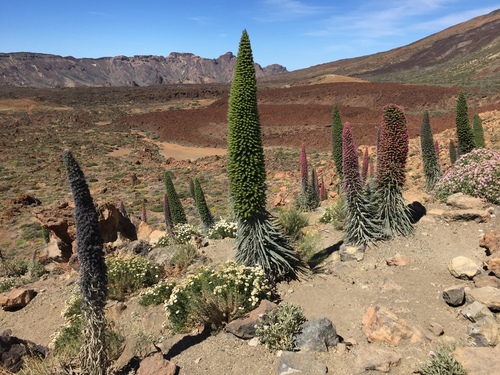
Plantago Webbii is a fascinating, hardy perennial shrub endemic to the high-altitude volcanic landscapes of the Canary Islands, particularly thriving in the subalpine zones of Tenerife, La Palma, and Gran Canaria. Growing as a low, dense, hemispherical cushion, this unique plant has adapted spectacularly to survive some of the most unforgiving environments in the archipelago, where intense solar radiation, dramatic temperature fluctuations, and drying winds dominate.
Hábitat: Found in high-altitude volcanic scrublands and rocky slopes of the Canary Islands, typically above 1,500 meters.
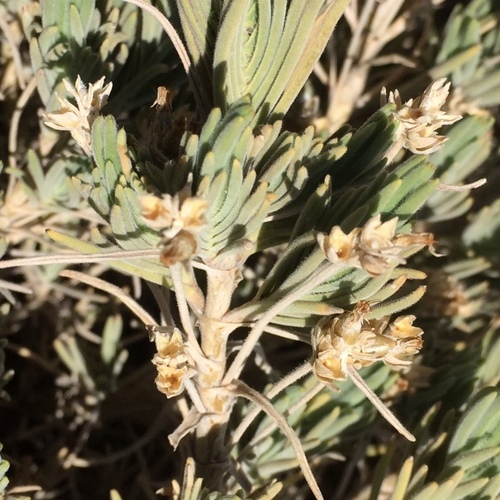
This species forms a compact, woody shrub reaching 10 to 40 centimeters in height. Its most striking feature is its dense arrangement of narrow, lanceolate leaves that are heavily blanketed in silky, silvery-white hairs, giving the entire plant a shimmering, pale sage-green appearance. During its flowering season, it sends up upright, cylindrical spikes packed with tiny, understated brownish-yellow flowers that rise above the foliage.
Categoría
PlantasRareza
Common
Peligro
1/5 · Muy bajo
Snaps
¡Sé la primera persona en hacer un snap!
Despite being a close relative of common lawn weeds, this plant has adapted to grow as a woody, long-lived shrub to survive rugged volcanic soil.
It is highly adapted to extreme temperature swings, enduring scorching daytime heat and freezing night temperatures in Tenerife's subalpine zone.
The dense silvery hairs covering its leaves act as a natural sunscreen, reflecting the harsh high-altitude UV radiation of the Canary Islands.
A dense covering of specialized silky white hairs reflects intense high-elevation ultraviolet radiation and reduces moisture loss from transpiration.
The low-lying, tightly branched hemispherical growth form helps the plant withstand powerful mountain winds and trap moisture.
An extensive, deep-reaching root system stabilizes the plant in highly unstable, porous pumice and loose volcanic scree.
As a photoautotrophic plant, it synthesizes its own food using sunlight, carbon dioxide, and water through the process of photosynthesis.
Gallotia galloti
Feeds on the flowers and fruits of the plant, acting as a potential seed dispersal agent.
Bombus canariensis
Visits the flowering spikes for pollen and nectar, acting as a primary pollinator.
Aún no hay insignias de rasgos asignadas a este objeto.
Todavía no hay alias listados.
Las colecciones para este objeto aparecerán aquí a medida que se añadan más temas.
Peligro
1/5 · Muy bajo
Todavía no hay notas especiales de seguridad.
La forma más fácil de identificar a Plantago Webbii es usar la aplicación de identificación de naturaleza Snappit.
10-40 cm
0.1-0.8 kg
5-20 años
As a photoautotrophic plant, it synthesizes its own food using sunlight, carbon dioxide, and water through the process of photosynthesis.
Found in high-altitude volcanic scrublands and rocky slopes of the Canary Islands, typically above 1,500 meters.
Acércate para separar los grupos y explorar dónde se ha fotografiado este objeto.
Los snaps recientes aparecerán aquí a medida que se añadan nuevas observaciones.