






Plum Pines
podocarpus
Plum Pines are tall trees with beautiful green needles that look like they belong in a fairy tale! They produce sweet, plum-like fruits that many animals love to eat.
Hábitat: Plum Pines are usually found in forests, especially in subtropical and tropical regions.
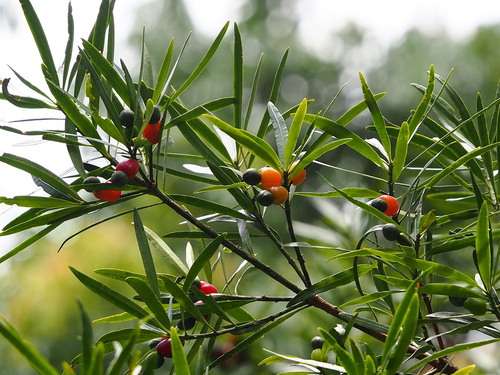
The Plum Pines is an evergreen conifer with dense, dark green, flattened needle-like leaves. It features distinctive, fleshy, often bright red or purple seed receptacles that resemble small berries, contrasting beautifully with its scaly, grey-brown bark.
Categoría
PlantasRareza
Common
Peligro
0/5 · Sin peligro conocido
Snaps
¡Sé la primera persona en hacer un snap!
Despite its name, Plum Pines isn't a true pine; its 'plums' are actually modified cones!
Some Plum Pines have ancient roots, thriving on Earth since the age of dinosaurs!
The tasty part of a Plum Pine seed isn't a fruit, but a fleshy stem called a receptacle!
They are found across continents, hinting at an ancient supercontinent called Gondwana!
Plum Pines has bright, fleshy seed coverings that attract birds and other animals, helping them scatter seeds far and wide for new growth.
Plum Pines can release millions of tiny pollen grains into the wind, allowing them to pollinate other trees across vast distances.
Plum Pines keeps its leaves all year, allowing it to photosynthesize and grow even when other trees have lost their foliage.
Turdus migratorius
eats the fleshy seed receptacle for energy
%2C_Parc_de_Woluw%C3%A9%2C_Brussels_(13042792905).jpg&width=800)
Parus major
nests in its dense foliage and branches
Russula brevipes
forms beneficial root connections for nutrient exchange
Los animales arborícolas viven principalmente en los árboles, utilizándolos como refugio, alimento y protección contra los depredadores.
Colorido describe a organismos u objetos que exhiben una amplia variedad de colores brillantes y distintivos.
Este rasgo caracteriza a los organismos cuya dieta consiste total o principalmente en material vegetal.
Los hábitats boscosos son entornos terrestres dominados por una densa cubierta arbórea, que sustentan una gran diversidad de vida animal y vegetal.

Los animales diurnos están activos principalmente durante el día y suelen descansar o dormir por la noche.
Peligro
0/5 · Sin peligro conocido
Todavía no hay notas especiales de seguridad.
1000-3000 cm
300-1000 cm
Primavera
Sí
Leve
Perenne
Viento
Plum Pines are usually found in forests, especially in subtropical and tropical regions.
Acércate para separar los grupos y explorar dónde se ha fotografiado este objeto.
Los snaps recientes aparecerán aquí a medida que se añadan nuevas observaciones.












_v2.jpg&width=800)



