

Pondside Crambid Moth
elophila icciusalis
The Pondside Crambid Moth (Elophila icciusalis) is a fascinating little moth deeply tied to freshwater environments. While most moths steer clear of water, this crambid species spends its larval stage fully submerged. The caterpillars are famous for constructing tiny, protective, portable cases from fragments of duckweed, pondweed, and other aquatic vegetation, breathing through specialized cutaneous respiration. Once they emerge as adults, these small, intricately patterned moths can be found fluttering delicately around the margins of ponds, marshes, and quiet lakes. They are highly active during the warmer months, contributing significantly to the wetland food web as both consumers of aquatic plants and prey for local fauna. Their dual-life journey from an underwater builder to a delicate aerial flyer makes them a marvel of insect adaptation.
Hábitat: Found in close proximity to freshwater habitats such as ponds, marshes, fens, and slow-moving streams where floating aquatic vegetation is abundant.
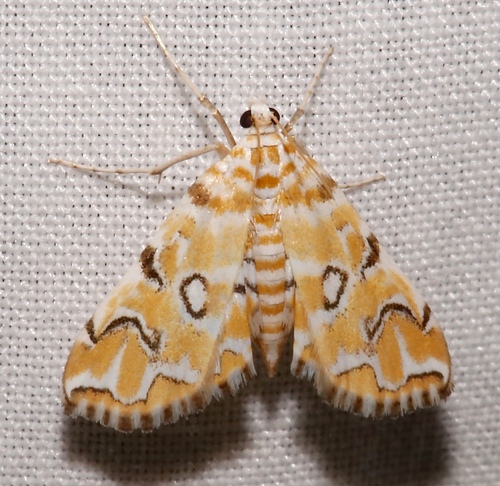
Adults of Elophila icciusalis are small, elegant moths with a wingspan of about 1 to 2 centimeters. Their forewings are intricately patterned with shades of pale cream, yellow-brown, and dark brown bands, often showing a distinctive white and brown wavy pattern. The hindwings are similarly light-colored with dark parallel lines running across them. The margins of their wings are fringed with fine hairs, giving them a soft, delicate appearance. Larvae are light green or cream-colored, typically hidden inside a flattened, bivalve-like leaf case.
Categoría
InsectosRareza
Common
Peligro
1/5 · Muy bajo
Snaps
¡Sé la primera persona en hacer un snap!
Adults are extremely light and can land on the water's surface film without sinking, quickly taking off again if disturbed.
The caterpillars are entirely aquatic and live inside a case filled with water, getting oxygen directly through their skin.
To make their cases, the caterpillars cut neat oval pieces out of duckweed or water lily leaves and silk them together.
Caterpillars are adapted to live underwater, absorbing dissolved oxygen directly through their skin and utilizing air trapped inside their portable leaf cases.
Larvae construct protective, portable shelters out of cut pieces of duckweed or pondweed, helping them camouflage and avoid aquatic predators.
Adult moths possess water-repellent scales on their wings and bodies, allowing them to escape easily if they accidentally touch the water's surface.
Larvae feed strictly on aquatic plants, while adults have highly reduced mouthparts and rarely, if ever, feed, relying entirely on larval energy reserves.
Diferencias por edad: Larvae feed voraciously on aquatic foliage, whereas adult moths do not feed, focusing solely on reproduction.
Lemna minor
Larvae use duckweed leaves both as a primary food source and to construct their protective portable cases.
Lepomis macrochirus
Bluegills and other small aquatic fish feed on the swimming or drifting larvae of the moth in shallow waters.
Lithobates clamitans
Green frogs sitting along pond edges readily snap up adult moths resting on emergent vegetation.
Aún no hay insignias de rasgos asignadas a este objeto.
Todavía no hay alias listados.
Las colecciones para este objeto aparecerán aquí a medida que se añadan más temas.
Peligro
1/5 · Muy bajo
Todavía no hay notas especiales de seguridad.
La forma más fácil de identificar a Pondside Crambid Moth es usar la aplicación de identificación de naturaleza Snappit.
1 cm
1-2 cm
0.00001-0.00003 kg
Larvae feed strictly on aquatic plants, while adults have highly reduced mouthparts and rarely, if ever, feed, relying entirely on larval energy reserves.
Found in close proximity to freshwater habitats such as ponds, marshes, fens, and slow-moving streams where floating aquatic vegetation is abundant.
Grazing
50-150
Acércate para separar los grupos y explorar dónde se ha fotografiado este objeto.
Los snaps recientes aparecerán aquí a medida que se añadan nuevas observaciones.