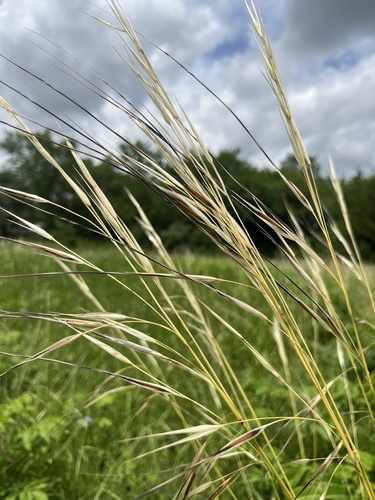


Porcupine Needlegrass
hesperostipa spartea
Porcupine Needlegrass is a striking, native perennial bunchgrass found across the North American prairies. It earns its common name from its exceptionally long, stiff, needle-like seeds and awns that closely resemble porcupine quills. These unique structures are an evolutionary marvel, designed to physically drill the plant's seeds into the soil to ensure successful germination in harsh, dry environments. Beyond its fascinating mechanics, this grass plays a crucial ecological role by providing essential forage and habitat for prairie wildlife. Its deep, fibrous root system also aids in soil stabilization, carbon sequestration, and drought resilience, making it a foundational species of healthy tallgrass and mixed-grass prairie ecosystems.
Hábitat: Typically found thriving in dry to mesic tallgrass prairies, sandy open woods, and rocky slopes across North America.
Porcupine Needlegrass typically grows in dense, erect clumps reaching heights of 60 to 120 centimeters. The stems are smooth and slender, supporting narrow, flat, or slightly rolled leaves that feel rough to the touch. The plant's most defining visual feature is its seed head: a narrow panicle containing long, sharply pointed seeds attached to prominent, twisted awns that can measure up to 10 to 20 centimeters in length. During the summer, these distinctive, needle-like awns turn a golden-brown hue and often twist tightly like corkscrews, arching out from the top of the grass clump.
Categoría
PlantasRareza
Common
Peligro
1/5 · Muy bajo
Snaps
¡Sé la primera persona en hacer un snap!
Indigenous peoples of North America historically used the long, stiff awns of this grass bundled together to make brushes and brooms.
The awns are so responsive to moisture that if you place a dry seed on a damp paper towel, you can actively watch it twist and coil before your eyes.
The needle-sharp seeds of Porcupine Needlegrass are strong enough to occasionally pierce the skin of grazing animals or get deeply tangled in livestock wool.
The plant's scientific specific epithet, 'spartea', is derived from a Latin word meaning 'broom', nodding directly to its historical human use.
The long awns attached to the seeds twist and untwist in response to changes in environmental humidity, physically driving the sharp seed deep into the soil.
It possesses an extensive, deep root system that allows it to access water far below the surface, surviving prolonged periods of intense heat and low rainfall.
The plant's growing points are located near or slightly below the soil surface, enabling it to quickly resprout and recover after typical seasonal prairie wildfires.
As a plant, Porcupine Needlegrass produces its own energy through photosynthesis, absorbing water and nutrients directly from the soil.
Ictidomys tridecemlineatus
Seeds and foliage are consumed by small prairie mammals.
Bison bison
Provides early-season grazing forage for large ungulates.
Hesperia dacotae
Serves as an essential host plant for the caterpillars of specific prairie butterflies.
Aún no hay insignias de rasgos asignadas a este objeto.
Todavía no hay alias listados.
Las colecciones para este objeto aparecerán aquí a medida que se añadan más temas.
Peligro
1/5 · Muy bajo
Todavía no hay notas especiales de seguridad.
La forma más fácil de identificar a Porcupine Needlegrass es usar la aplicación de identificación de naturaleza Snappit.
60-120 cm
5-20 años
As a plant, Porcupine Needlegrass produces its own energy through photosynthesis, absorbing water and nutrients directly from the soil.
Typically found thriving in dry to mesic tallgrass prairies, sandy open woods, and rocky slopes across North America.
14-30 días
Acércate para separar los grupos y explorar dónde se ha fotografiado este objeto.
Los snaps recientes aparecerán aquí a medida que se añadan nuevas observaciones.




















