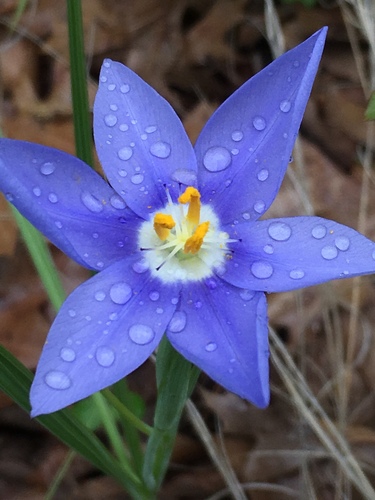


Prairie Pleatleaf
nemastylis geminiflora
A delightful native wildflower of the American prairies, the Prairie Pleatleaf (Nemastylis geminiflora) is cherished for its brilliant, celestial-blue blossoms that appear like scattered jewels in spring grasslands. Growing from a hardy underground bulb, this perennial member of the iris family is well-adapted to the harsh and variable conditions of open plains and limestone glades. Its most striking feature, other than its stunning color, is its incredibly brief blooming window, making a sighting of this plant in full flower a rewarding treat for nature lovers. Also known as 'celestials,' these plants play a subtle but vital role in local grassland ecosystems, providing early-season nectar for native bees and wild pollinators. Despite their delicate appearance, they are tough survivors, utilizing pleated, fan-like leaves to withstand dry winds.
Hábitat: Found in native tallgrass prairies, limestone glades, open meadows, and grassy roadsides.
The Prairie Pleatleaf features elegant, six-petaled flowers that are light blue to deep violet-blue, with a white center and bright yellow-orange stamens. Each flower measures about 3 to 5 centimeters across. Its leaves are narrow, long, grass-like, and highly distinctive due to their deep, longitudinal pleats that resemble an accordion. The plant grows on slender, upright stems that typically reach 15 to 45 centimeters in height.
Categoría
PlantasRareza
Common
Peligro
1/5 · Muy bajo
Snaps
¡Sé la primera persona en hacer un snap!
Its scientific name 'geminiflora' means 'twin-flowered,' referring to the way its flowers often emerge in pairs from the stem bracts.
The flowers of the Prairie Pleatleaf are incredibly short-lived, remaining open for only about four to five hours on a single day.
When the flower's brief blooming time ends, the delicate petals liquefy and dissolve into a dark blue, jelly-like substance.
The flower buds open in the mid-morning and wither by early afternoon, minimizing water loss during the hottest part of the day.
Deeply folded leaves act like natural rain gutters, effectively funneling morning dew and rain straight down to the root system.
An underground bulb protects the plant's vital energy reserves from scorching prairie fires and severe winter frosts.
As a photosynthetic plant, it generates its own energy from sunlight, carbon dioxide, water, and soil nutrients.
Apis mellifera
Sips nectar and collects pollen, aiding in the pollination of the ephemeral flowers.
Bombus pensylvanicus
Serves as an efficient native pollinator that visits the flowers during their brief morning bloom.
Odocoileus virginianus
Grazes on the tender spring foliage and flower heads in prairie habitats.
Aún no hay insignias de rasgos asignadas a este objeto.
Todavía no hay alias listados.
Las colecciones para este objeto aparecerán aquí a medida que se añadan más temas.
Peligro
1/5 · Muy bajo
Todavía no hay notas especiales de seguridad.
La forma más fácil de identificar a Prairie Pleatleaf es usar la aplicación de identificación de naturaleza Snappit.
15+ cm
0.01+ kg
As a photosynthetic plant, it generates its own energy from sunlight, carbon dioxide, water, and soil nutrients.
Found in native tallgrass prairies, limestone glades, open meadows, and grassy roadsides.
Acércate para separar los grupos y explorar dónde se ha fotografiado este objeto.
Los snaps recientes aparecerán aquí a medida que se añadan nuevas observaciones.