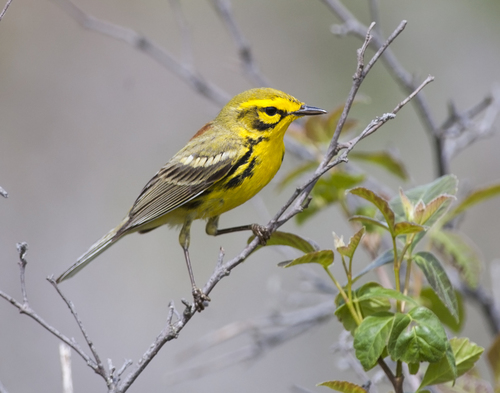


Prairie Warbler
setophaga discolor
The Prairie Warbler (Setophaga discolor) is a lively, brightly colored songbird that brings a flash of yellow and a distinctive buzzy trill to the shrublands of eastern North America. Despite its common name, this species actually avoids true open prairies, preferring early-successional habitats like overgrown fields, young pine stands, and coastal mangroves. A highly active forager, the Prairie Warbler flits restlessly through low vegetation, constantly bobbing its tail as it searches for small insect prey. What makes this warbler particularly interesting is its reliance on ephemeral environments. It thrives in areas recovering from natural or human disturbances, such as forest fires, clearcuts, or abandoned agricultural land. As these scrubby habitats mature into full forests, the Prairie Warbler must migrate or relocate to find new breeding grounds. This specialized habitat requirement, coupled with its energetic tail-wagging behavior and cheerful, ascending song, makes spotting the Prairie Warbler a highly rewarding experience for birdwatchers exploring the brushy edges of the eastern United States.
Hábitat: Found in early-successional shrublands, overgrown pastures, young pine clearcuts, and coastal mangroves, rather than actual open prairies.
The Prairie Warbler is a small, vibrant songbird measuring about 11 to 13 centimeters in length with a wingspan of roughly 18 centimeters. Adult males are striking, featuring bright yellow underparts strongly marked with bold black streaks along their flanks. Their upperparts are an olive-green, often accented with a subtle patch of chestnut or reddish-brown speckling in the center of their back. The face has a distinct, contrasting pattern, characterized by a dark line running through the eye and a black semi-circle just below it, framing a bright yellow cheek. Females and immature birds display a similar but much duller color palette, with washed-out yellow underparts, fainter streaking, and less pronounced facial markings.
Categoría
AvesRareza
Common
Peligro
1/5 · Muy bajo
Snaps
¡Sé la primera persona en hacer un snap!
It is one of the few North American warblers that constantly bobs its tail, a behavior it shares prominently with the Palm Warbler.
The Prairie Warbler's name is a misnomer; it was named by ornithologist Alexander Wilson who first discovered the bird in a barren, scrubby tract of land in Kentucky that he loosely called a 'prairie'.
There is a unique subspecies of Prairie Warbler (Setophaga discolor paludicola) that lives year-round in the coastal mangrove swamps of Florida, never migrating like its northern relatives.
Unlike many woodland songbirds that lose their homes to logging, the Prairie Warbler actually relies on disturbances like clearcutting and forest fires to create the brushy early-successional habitats it needs to breed.
Habitually wags its tail up and down as it perches or forages, a behavior that may help startle hiding insects or serve as visual communication.
Capable of hovering briefly in mid-air to pluck concealed insects and spiders from the undersides of leaves and twigs.
Males defend their territory by singing a distinct, rapidly rising series of buzzy notes that carry surprisingly well through dense brush.
The Prairie Warbler feeds almost exclusively on small insects and spiders gleaned from the foliage of low trees and shrubs.
Diferencias por edad: Nestlings are fed primarily soft-bodied insects, especially small caterpillars, to ease digestion.
Molothrus ater
Frequently parasitizes Prairie Warbler nests, laying its eggs for the warblers to raise.
Thamnophis sirtalis
Preys on the eggs and nestlings of the ground- or low-shrub-nesting Prairie Warblers.
Rhizophora mangle
Provides critical year-round breeding and foraging habitat for the distinct Florida subspecies.
Aún no hay insignias de rasgos asignadas a este objeto.
Todavía no hay alias listados.
Las colecciones para este objeto aparecerán aquí a medida que se añadan más temas.
Peligro
1/5 · Muy bajo
Todavía no hay notas especiales de seguridad.
La forma más fácil de identificar a Prairie Warbler es usar la aplicación de identificación de naturaleza Snappit.
11-13 cm
17-19 cm
0.007-0.009 kg
3-10 años
35 km/h
The Prairie Warbler feeds almost exclusively on small insects and spiders gleaned from the foliage of low trees and shrubs.
Found in early-successional shrublands, overgrown pastures, young pine clearcuts, and coastal mangroves, rather than actual open prairies.
Acércate para separar los grupos y explorar dónde se ha fotografiado este objeto.
Los snaps recientes aparecerán aquí a medida que se añadan nuevas observaciones.




.jpg&width=800)














.jpg&width=800)
