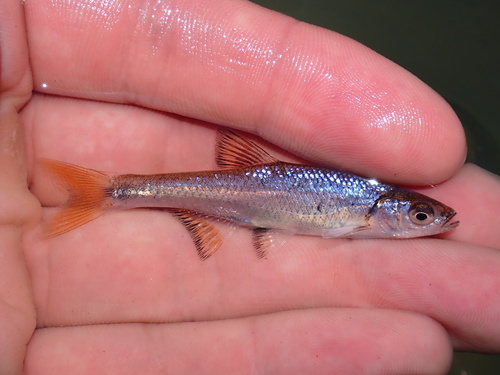


Pretty Shiner
lythrurus bellus
The Pretty Shiner (Lythrurus bellus) is a small, energetic freshwater fish native to the river basins of the southeastern United States, particularly within the Mobile Bay drainage. True to its name, this species is a delightful sight in clear streams and creeks, where large schools can be seen darting over gravelly substrates. Known for their lively nature and brilliant appearance, these minnows are essential components of their native aquatic ecosystems, serving as an important food source for larger predatory fish and helping control aquatic insect populations. During the spring and summer spawning season, the Pretty Shiner truly earns its moniker. Breeding males undergo a stunning transformation, developing vivid red and orange coloration on their fins and bodies, alongside small nuptial tubercles on their heads. This temporary, radiant display makes them highly sought after by native fish enthusiasts and stream explorers alike.
Hábitat: Typically found in small to medium-sized freshwater streams with clear to slightly turbid water, moderate currents, and sandy or gravelly substrates.
The Pretty Shiner is a slender, compressed minnow growing up to 9 centimeters in length. It features a silvery-olive body with a dark lateral stripe running from the gill cover to the tail, and a distinct black spot at the base of the dorsal fin. Outside of breeding season, its coloration is relatively modest with silver sides and pale fins. However, during spawning, males develop intense red to orange pigmentation across all fins, a flushed reddish throat, and tiny white bumps called tubercles on their snout and head, while females retain a subtler, silvery sheen.
Categoría
PecesRareza
Common
Peligro
1/5 · Muy bajo
Snaps
¡Sé la primera persona en hacer un snap!
Despite their name, 'shiners' get their reflective sheen from guanine crystals stored in their scales, which bounce sunlight to confuse predators.
The scientific genus name Lythrurus translates to 'blood tail' in Greek, referencing the bright red coloration seen on the tails of breeding males.
They often use the nests of other larger fish, like sunfishes or larger minnows, to deposit their eggs, taking advantage of the host's nest defense.
During the breeding season, males grow small, abrasive keratinized bumps on their heads used to defend nesting territories and stimulate females during spawning.
They exhibit coordinated schooling behaviors, utilizing rapid changes in direction to confuse predators in flowing water.
They can rapidly intensify their body coloration from a subtle silver to a vibrant fiery red in response to hormonal changes and social cues during mating season.
Feeds opportunistically on a mixture of aquatic insects, terrestrial drift, and small amounts of organic plant material or algae.
Diferencias por edad: Juveniles feed primarily on microscopic zooplankton, transitioning to larger aquatic insect larvae and terrestrial insects as they mature.
Simulium vittatum
Predates upon the aquatic larvae of this insect in shallow riffles.
Micropterus salmoides
A major predator that hunts Pretty Shiners in deeper stream pools.
Cyprinella trichroistia
Competes for food resources and spawning space in the same stream runs.
Aún no hay insignias de rasgos asignadas a este objeto.
Todavía no hay alias listados.
Las colecciones para este objeto aparecerán aquí a medida que se añadan más temas.
Peligro
1/5 · Muy bajo
Todavía no hay notas especiales de seguridad.
La forma más fácil de identificar a Pretty Shiner es usar la aplicación de identificación de naturaleza Snappit.
4-9 cm
0.002-0.008 kg
2-3 años
Feeds opportunistically on a mixture of aquatic insects, terrestrial drift, and small amounts of organic plant material or algae.
Typically found in small to medium-sized freshwater streams with clear to slightly turbid water, moderate currents, and sandy or gravelly substrates.
Foraging
100-1000
Acércate para separar los grupos y explorar dónde se ha fotografiado este objeto.
Los snaps recientes aparecerán aquí a medida que se añadan nuevas observaciones.


















