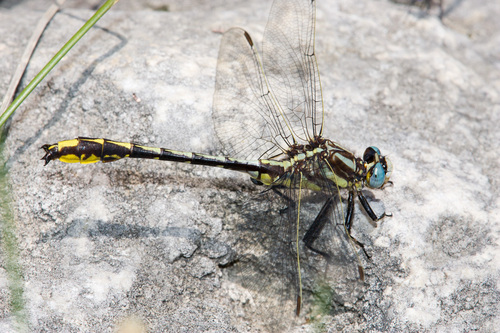


Pronghorn Clubtail
phanogomphus graslinellus
The Pronghorn Clubtail (Phanogomphus graslinellus) is an elegant, medium-sized dragonfly belonging to the clubtail family, Gomphidae. Highly adapted to riverine and lakeside ecosystems across North America, these insects are remarkable aerial predators that spend their days hunting on the wing or basking on sunny rocks and paths near the water's edge. Like other clubtails, they get their name from the distinctively widened segments near the tip of their abdomen, which looks like a small club. They serve as valuable biological indicators of water quality, as their nymphs require clean, oxygenated aquatic environments to develop.
Hábitat: Found near slow-moving muddy or sandy-bottomed rivers, streams, lakes, and ponds.
This dragonfly typically measures between 4 and 6 centimeters in length, with a wingspan of 6 to 8 centimeters. It possesses a dark brown or black abdomen accented with bright yellow-green spots along the top, ending in a noticeable 'club' shape. The thorax is vivid green or yellow, patterned with bold dark brown stripes, and its widely separated compound eyes are a brilliant grey-green or blue-green color. Males can be distinguished by the small, horn-like prongs on their terminal appendages, giving the species its common name.
Categoría
InsectosRareza
Common
Peligro
1/5 · Muy bajo
Snaps
¡Sé la primera persona en hacer un snap!
The 'pronghorn' in their common name refers to the tiny prong-like projections on the male's claspers, which are used to hold the female during mating.
They spend up to two years of their life cycle as aquatic nymphs underwater, but live for only a few weeks as winged adults.
Unlike most other dragonflies that perch on twigs or leaves, clubtails prefer resting flat on the ground, bare soil, or flat rocks.
Features large, widely separated compound eyes that provide an almost 360-degree field of view to spot prey and evade predators.
Capable of rapid acceleration and agile banking maneuvers to intercept flying insects mid-air with high precision.
The aquatic nymphs possess flat bodies and specialized legs designed for burrowing into sandy or muddy riverbeds to ambush prey.
Adults are active aerial predators that hunt flying insects, whereas the aquatic nymphs ambush small aquatic organisms from the riverbed.
Diferencias por edad: Nymphs live underwater and feed on aquatic invertebrates like mosquito larvae and small worms, whereas adults are purely aerial predators feeding on flying insects.
Lithobates catesbeianus
American Bullfrogs regularly ambush adult dragonflies resting on low shoreline vegetation or shoreline mud.
Tyrannus tyrannus
Eastern Kingbirds are skilled flycatchers that actively hunt and capture adult Pronghorn Clubtails in mid-air.
Enallagma cyathigerum
Pronghorn Clubtail adults prey upon smaller odonates like damselflies near their aquatic breeding sites.
Aún no hay insignias de rasgos asignadas a este objeto.
Todavía no hay alias listados.
Las colecciones para este objeto aparecerán aquí a medida que se añadan más temas.
Peligro
1/5 · Muy bajo
Todavía no hay notas especiales de seguridad.
La forma más fácil de identificar a Pronghorn Clubtail es usar la aplicación de identificación de naturaleza Snappit.
4-6 cm
6-8 cm
0.001-0.002 kg
1-2 años
30 km/h
Adults are active aerial predators that hunt flying insects, whereas the aquatic nymphs ambush small aquatic organisms from the riverbed.
Found near slow-moving muddy or sandy-bottomed rivers, streams, lakes, and ponds.
Acércate para separar los grupos y explorar dónde se ha fotografiado este objeto.
Los snaps recientes aparecerán aquí a medida que se añadan nuevas observaciones.











