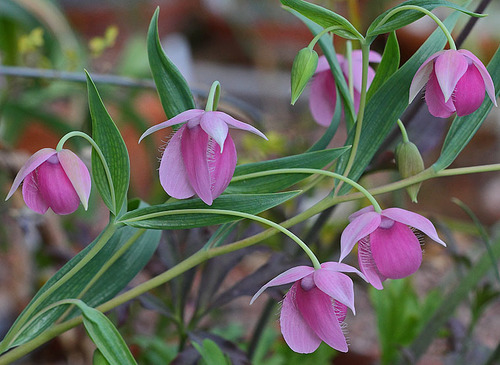


Purple Fairy-Lantern
calochortus amoenus
The Purple Fairy-Lantern (Calochortus amoenus) is an enchanting wildflower native to California, known for its distinctly shaped, pendant blossoms. This species belongs to the diverse Calochortus genus, often referred to as Mariposa lilies, Globe lilies, or Star tulips, each with its own unique floral architecture. The Purple Fairy-Lantern stands out with its charming, closed-bell flowers that evoke images of tiny, delicate lanterns swaying gently in the breeze. Its presence signifies the rich biodiversity of California's coastal ranges and woodlands, where it adds a splash of vibrant color and intricate beauty to its shaded habitats. It's a perennial plant, relying on an underground bulb to persist through dry seasons and re-emerge with renewed vitality.
Hábitat: This species thrives on shaded hillsides, in open woodlands, and chaparral communities within the Coast Ranges of central and southern California.
The Purple Fairy-Lantern typically grows to a height of 15 to 60 centimeters. Its most striking feature is its globular, bell-shaped flowers, which hang downwards, usually appearing in shades of rosy-purple or deep pink. Each flower has three petals that are covered in fine, silky hairs on their inner surface, contributing to a soft, fuzzy texture and often a darker blotch at the base. The outer sepals are smaller, often greenish, and boat-shaped. The leaves are grass-like and basal, usually appearing before the flowering stem emerges.
Categoría
PlantasRareza
Common
Peligro
1/5 · Muy bajo
Snaps
¡Sé la primera persona en hacer un snap!
Like many species in the Calochortus genus, its bulbs were historically gathered and eaten by indigenous peoples of California, often roasted or boiled.
The common name 'Fairy-Lantern' perfectly describes its pendant, bell-shaped flowers, which seem to hang like delicate, ethereal lights.
The genus name 'Calochortus' comes from Greek words 'kalos' (beautiful) and 'chortos' (grass), referring to the plant's elegant flowers and grass-like leaves.
The intricate hairs inside the petals of the Purple Fairy-Lantern are a distinctive feature, playing a role in attracting specific pollinators or possibly deterring generalist feeders.
Purple Fairy-Lanterns possess underground bulbs that store nutrients, enabling them to survive prolonged periods of drought or dormancy during the dry summer months, re-emerging with favorable conditions.
The unique, closed-bell shape and hairy petals of the flowers are adapted to attract specific native pollinators, such as solitary bees, which are efficient at navigating its intricate floral structure.
The plant's underground bulbs offer protection from wildfires, allowing the species to resprout and even benefit from the post-fire nutrient flush and reduced competition, demonstrating a degree of pyrophyte adaptation.
As a plant, the Purple Fairy-Lantern produces its own food through photosynthesis, converting sunlight, carbon dioxide, and water into sugars. It absorbs essential minerals and water from the soil through its root system.
Andrena spp.
Pollinator for the flower's reproduction, attracted by nectar and pollen.
Odocoileus hemionus
Feeds on the foliage, especially younger plants or shoots.
Various species
Benefits from nutrient exchange with the plant's roots.
Thomomys bottae
Consumes the bulbs, especially during dormant periods.
Aún no hay insignias de rasgos asignadas a este objeto.
Todavía no hay alias listados.
Las colecciones para este objeto aparecerán aquí a medida que se añadan más temas.
Peligro
1/5 · Muy bajo
Todavía no hay notas especiales de seguridad.
La forma más fácil de identificar a Purple Fairy-Lantern es usar la aplicación de identificación de naturaleza Snappit.
15-60 cm
3-10 años
As a plant, the Purple Fairy-Lantern produces its own food through photosynthesis, converting sunlight, carbon dioxide, and water into sugars. It absorbs essential minerals and water from the soil through its root system.
This species thrives on shaded hillsides, in open woodlands, and chaparral communities within the Coast Ranges of central and southern California.
50-150
Acércate para separar los grupos y explorar dónde se ha fotografiado este objeto.
Los snaps recientes aparecerán aquí a medida que se añadan nuevas observaciones.













