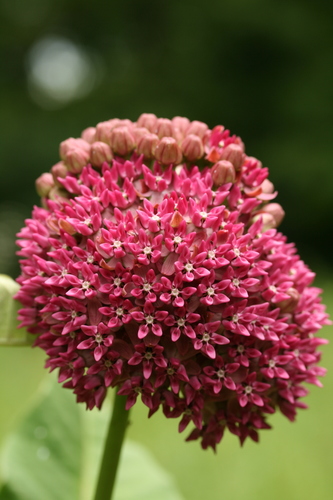


Purple Milkweed
asclepias purpurascens
Purple Milkweed (Asclepias purpurascens) is an elegant, herbaceous perennial native to the eastern and central United States and parts of Canada. Renowned for its stunning, deep rose-purple flower clusters, this plant is a highly sought-after species for native plant gardeners and wildlife enthusiasts alike. Unlike its highly aggressive relative, the Common Milkweed, Purple Milkweed grows in well-behaved clumps and is far more selective about its habitat. It plays an essential role in supporting local ecosystems, particularly as a vital nectar source for native bumblebees, butterflies, and hummingbirds. Its milky, latex-filled sap contains defensive cardenolides, which render the plant toxic to most herbivores while providing chemical protection to specialized insects that feed on it.
Hábitat: Typically found in semi-shaded habitats such as open oak woodlands, thickets, forest margins, and sandy savannas.
This robust plant stands between 60 to 100 cm tall, featuring thick, opposite, ovate-oblong leaves with short petioles and fine hairs on their undersides. The most distinctive feature is the dense, dome-shaped clusters (umbels) of intense magenta to deep purple flowers blooming from late spring to mid-summer. Unlike the bumpy seed pods of Common Milkweed, the pods (follicles) of the Purple Milkweed are smooth and downy, eventually splitting to release dark brown seeds equipped with silky white fibers that catch the wind.
Categoría
PlantasRareza
Common
Peligro
1/5 · Muy bajo
Snaps
¡Sé la primera persona en hacer un snap!
Its specific scientific name, 'purpurascens', is Latin for 'becoming purple', referencing its transition to magnificent violet blooms.
The silky seed floss was collected by schoolchildren during World War II to stuff military lifejackets because of its superior buoyancy and insulating properties.
Unlike the common milkweed, which aggressively spreads through deep underground runners, Purple Milkweed grows in polite, non-invasive clumps.
Produces a white, sticky latex sap containing cardenolides (cardiac glycosides) that are toxic to most herbivores.
Flowers use specialized, sticky pollen sacs called pollinia that temporarily clamp onto visiting insects' legs to ensure highly efficient cross-pollination.
Each seed is equipped with a tuft of lightweight, silky hairs (coma) designed to catch drafts and float long distances away from the parent plant.
As a photosynthetic plant, it synthesizes its own sugars using sunlight, water, carbon dioxide, and essential soil macronutrients.
Danaus plexippus
Provides critical larval food and chemical protection for caterpillars.
Bombus impatiens
Relies heavily on long-tongued bees for pollination in exchange for rich nectar.
Euchaetes egle
Voracious caterpillars defoliate leaves while tolerating the plant's chemical defenses.
Aún no hay insignias de rasgos asignadas a este objeto.
Todavía no hay alias listados.
Las colecciones para este objeto aparecerán aquí a medida que se añadan más temas.
Peligro
1/5 · Muy bajo
Todavía no hay notas especiales de seguridad.
La forma más fácil de identificar a Purple Milkweed es usar la aplicación de identificación de naturaleza Snappit.
60-100 cm
5-20 años
As a photosynthetic plant, it synthesizes its own sugars using sunlight, water, carbon dioxide, and essential soil macronutrients.
Typically found in semi-shaded habitats such as open oak woodlands, thickets, forest margins, and sandy savannas.
Acércate para separar los grupos y explorar dónde se ha fotografiado este objeto.
Los snaps recientes aparecerán aquí a medida que se añadan nuevas observaciones.




.jpg&width=800)