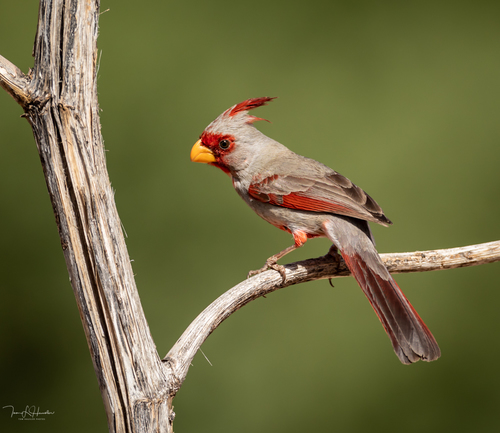


Pyrrhuloxia
cardinalis sinuatus
The Pyrrhuloxia, also known as the desert cardinal, is an enchanting songbird of the arid American Southwest and northern Mexico. Often mistaken for its close relative, the Northern Cardinal, this resilient bird is wonderfully adapted to thrive in harsh, dry scrublands. Its striking, parrot-like yellow bill and elegant gray-and-crimson plumage make it a favorite among desert birdwatchers. Pyrrhuloxias are social birds during the winter, gathering in large foraging flocks, but they fiercely defend their territories in the breeding season. With a song that is sweet and piercing, the Pyrrhuloxia breathes life into the quiet desert morning. Its name is a combination of Greek terms referring to its curved bill and fiery red accents. Whether darting through mesquite thickets or hopping on the ground in search of seeds, this charming cardinal relative is a testament to survival in some of the continent's most beautiful yet unforgiving landscapes.
Hábitat: Typically found in arid desert scrublands, mesquite bosques, and dry brushy habitats of the southwestern United States and Mexico.
The Pyrrhuloxia is medium-sized, measuring about 21 centimeters in length, with a distinctive, stout, strongly curved yellowish-gray bill resembling that of a parrot. Males are predominantly brownish-gray with striking flashes of rose-red on their crest, throat, chest, belly, and tail. Females are paler and mostly gray, with much more subtle reddish highlights on their crest and underparts. Both sexes sport a tall, expressive, pointed feather crest that they raise when alert, and long, elegant tails that aid in agile flight through dense desert brush.
Categoría
AvesRareza
Common
Peligro
1/5 · Muy bajo
Snaps
¡Sé la primera persona en hacer un snap!
The name Pyrrhuloxia is derived from Greek terms meaning fire-colored and crooked-billed, perfectly describing its appearance.
They frequently hybridize with Northern Cardinals where their territories overlap, producing offspring with intermediate features and songs.
Unlike many territorial birds that remain solitary or paired, Pyrrhuloxias can gather in massive foraging flocks of up to 1,000 birds during the dry winter months.
Its stout, strongly curved bill allows it to crack open exceptionally tough seeds and hard desert pods that other songbirds cannot access.
Exhibits highly efficient water conservation, obtaining much of its required moisture directly from the insects and fleshy cactus fruits it consumes.
Possesses a rich, liquid whistle that can sound incredibly similar to the Northern Cardinal, used to claim territories and signal family members across open desert.
Feeds primarily on a diverse mix of seeds, grains, and wild desert fruits, supplemented heavily with insects during the breeding season to feed growing chicks.
Prosopis glandulosa
The Pyrrhuloxia relies on this plant for nesting sites, protective cover, and a key food source through its seeds.
Accipiter cooperii
Frequently preys upon adults and juveniles, hunting them within their brushy habitats.
Cardinalis cardinalis
Compete directly for territorial boundaries and food resources in regions where their geographic ranges overlap.
Aún no hay insignias de rasgos asignadas a este objeto.
Todavía no hay alias listados.
Las colecciones para este objeto aparecerán aquí a medida que se añadan más temas.
Peligro
1/5 · Muy bajo
Todavía no hay notas especiales de seguridad.
La forma más fácil de identificar a Pyrrhuloxia es usar la aplicación de identificación de naturaleza Snappit.
19-23 cm
25-30 cm
0.024-0.043 kg
3-9 años
35 km/h
Feeds primarily on a diverse mix of seeds, grains, and wild desert fruits, supplemented heavily with insects during the breeding season to feed growing chicks.
Typically found in arid desert scrublands, mesquite bosques, and dry brushy habitats of the southwestern United States and Mexico.
Acércate para separar los grupos y explorar dónde se ha fotografiado este objeto.
Los snaps recientes aparecerán aquí a medida que se añadan nuevas observaciones.