

Quercus Berberidifolia
quercus berberidifolia
Quercus berberidifolia, commonly known as the California scrub oak, is a highly resilient evergreen shrub or small tree native to the chaparral ecosystems of California. This sturdy woody plant is a cornerstone of its habitat, providing crucial erosion control on dry hillsides and serving as an invaluable source of food and shelter for a diverse array of local wildlife. Capable of surviving intense summer droughts and recurring wildfires, it embodies the rugged endurance of California's native flora.
Hábitat: Found primarily in dry chaparral, coastal sage scrub, and open oak woodland ecosystems across California.
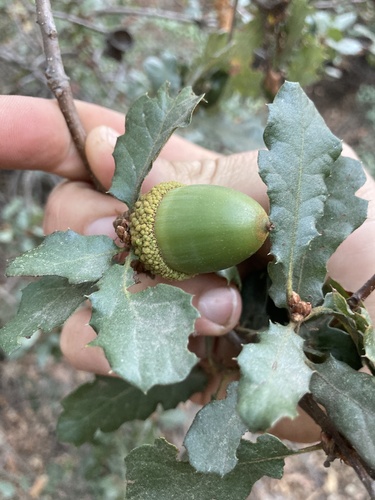
This evergreen shrub typically grows between 100 to 400 centimeters in height, forming dense, twiggy thickets. Its leaves are small, leathery, and oval-shaped, characterized by sharp, spiny margins that resemble holly. The upper leaf surface is a dull, dusty green, while the underside is a paler gray-green and covered in tiny, fine hairs. During autumn, it produces distinctive egg-shaped acorns that sit in shallow, scaly caps.
Categoría
PlantasRareza
Common
Peligro
1/5 · Muy bajo
Snaps
¡Sé la primera persona en hacer un snap!
Despite its small, scrubby, bush-like appearance, it is a true member of the oak family, sharing the same genus as giant forest oaks.
Its species name 'berberidifolia' means 'barberry-leaved', referring to the resemblance of its prickly leaves to those of barberry shrubs.
The acorns of this plant were historically harvested, leached of tannins, and ground into meal by Indigenous Californian tribes.
After a wildfire consumes its above-ground foliage, this plant can quickly regenerate from its underground root crown, ensuring rapid recovery.
Utilizes a deep taproot system combined with waxy, leathery leaves to minimize moisture loss and survive prolonged dry seasons.
Produces sharply-toothed leaf margins that act as a mechanical deterrent against heavy browsing by herbivores.
As an autotrophic plant, it produces its own energy via photosynthesis, converting sunlight, water, and carbon dioxide into sugars.
Aphelocoma californica
The scrub-jay caches and buries the acorns, unknowingly planting new oak trees when they forget where they hid them.
Odocoileus hemionus
Feeds on the leaves, young shoots, and nutrient-dense acorns of the scrub oak.
Andricus quercuscalifornicus
Lays eggs in the twigs of the oak, causing the plant to grow bright, spiky galls that shield the wasp larvae.
Aún no hay insignias de rasgos asignadas a este objeto.
Las colecciones para este objeto aparecerán aquí a medida que se añadan más temas.
Peligro
1/5 · Muy bajo
Todavía no hay notas especiales de seguridad.
La forma más fácil de identificar a Quercus Berberidifolia es usar la aplicación de identificación de naturaleza Snappit.
100-400 cm
50-150 años
As an autotrophic plant, it produces its own energy via photosynthesis, converting sunlight, water, and carbon dioxide into sugars.
Found primarily in dry chaparral, coastal sage scrub, and open oak woodland ecosystems across California.
Acércate para separar los grupos y explorar dónde se ha fotografiado este objeto.
Los snaps recientes aparecerán aquí a medida que se añadan nuevas observaciones.