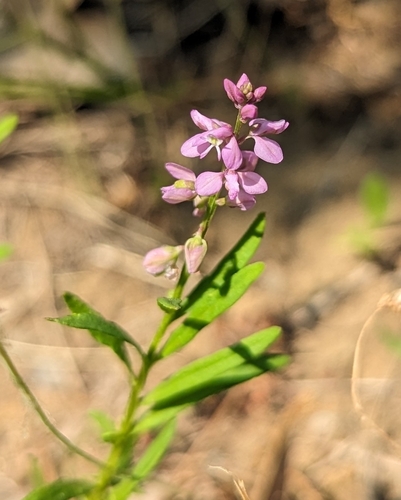


Racemed Milkwort
senega polygama
Racemed Milkwort (Senega polygama) is a fascinating, low-growing herbaceous plant native to the sandy woodlands, barrens, and prairies of eastern and central North America. Renowned among botanists for its unique dual-flowering strategy, this resilient biennial or short-lived perennial goes to great lengths to ensure its survival in harsh environments. Above ground, it produces showy, bright pink to purplish blossoms that attract a variety of insect pollinators. However, simultaneously and completely out of sight, it develops hidden, self-pollinating flowers on pale stems trailing just beneath the soil or leaf litter. This clever botanical insurance policy guarantees reproductive success even if above-ground conditions are unfavorable or pollinators are scarce. Its subtle beauty, combined with its highly complex reproductive ecology involving ants and underground blooming, makes it a treasured find for native plant enthusiasts exploring dry, open habitats.
Hábitat: Found in dry, sandy soils, including open pine barrens, coastal plains, prairies, and sunny woodland clearings.
Typically growing between 10 to 25 centimeters tall, Racemed Milkwort features slender, unbranched stems lined with small, alternating, narrow green leaves. During early to mid-summer, the plant is crowned by a loose terminal raceme of irregular, bright pink to rose-purple flowers, which have two flaring, petal-like sepals that resemble tiny wings. Hidden at the base of the plant, often buried in the soil or leaf litter, are pale, bud-like cleistogamous flowers that never open.
Categoría
PlantasRareza
Common
Peligro
1/5 · Muy bajo
Snaps
¡Sé la primera persona en hacer un snap!
Because its seeds are distributed by ants, patches of Racemed Milkwort often slowly migrate along ancient ant trails in sandy forests.
Racemed Milkwort operates like an botanical insurance policy: if pollinators fail to visit its showy pink flowers, its hidden underground flowers will still produce viable seeds.
The name 'milkwort' stems from a centuries-old European belief that grazing cows on related plants would increase their milk yield.
Produces hidden, closed flowers underground that self-pollinate, ensuring seed production without the need for insects.
Seeds produce a fleshy, nutrient-rich appendage called an elaiosome that attracts ants, which carry the seeds to their nests and inadvertently plant them.
Deep taproots and narrow leaves allow the plant to thrive in dry, sandy, and nutrient-poor environments where many other plants struggle.
As a photosynthetic plant, Racemed Milkwort produces its own food using sunlight, water, and carbon dioxide from its environment.
Aphaenogaster rudis
Ants harvest the seeds for their nutritious elaiosomes, inadvertently planting them in the soil.
Bombus impatiens
Bumble bees visit the above-ground open flowers to collect nectar and pollen.
Odocoileus virginianus
Browsing mammals occasionally eat the above-ground foliage.
Aún no hay insignias de rasgos asignadas a este objeto.
Todavía no hay alias listados.
Las colecciones para este objeto aparecerán aquí a medida que se añadan más temas.
Peligro
1/5 · Muy bajo
Todavía no hay notas especiales de seguridad.
La forma más fácil de identificar a Racemed Milkwort es usar la aplicación de identificación de naturaleza Snappit.
10-25 cm
2-5 años
As a photosynthetic plant, Racemed Milkwort produces its own food using sunlight, water, and carbon dioxide from its environment.
Found in dry, sandy soils, including open pine barrens, coastal plains, prairies, and sunny woodland clearings.
Photosynthesis
Acércate para separar los grupos y explorar dónde se ha fotografiado este objeto.
Los snaps recientes aparecerán aquí a medida que se añadan nuevas observaciones.









.jpg&width=800)



