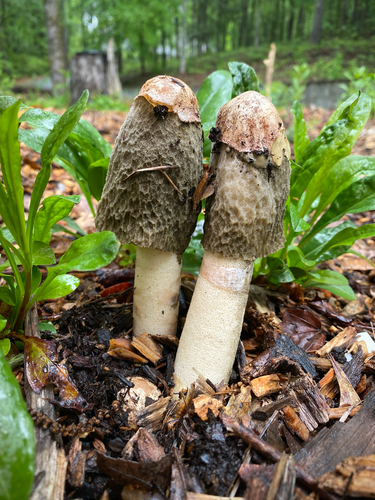


Ravenel'S Stinkhorn
phallus ravenelii
Ravenel's Stinkhorn (Phallus ravenelii) is a fascinating, albeit smelly, member of the Phallaceae family. Encountered in forests, gardens, and woodchips across North America, this fungus is famous for its rapid development and pungent odor. Emerging from a subterranean, egg-like structure, it grows into an upright stalk topped with a spore-bearing cap in just a few hours. Its foul scent, reminiscent of rotting meat, is actually a brilliant evolutionary strategy designed to attract insects, which assist in propagating the species. While its appearance and smell can be shocking to casual hikers, Ravenel's Stinkhorn plays a vital role as a decomposer, recycling nutrients back into the soil. It showcases the incredible diversity of fungal reproduction and serves as a reminder of the complex, often bizarre interactions that drive forest ecosystems.
Hábitat: Typically found growing on wood chips, mulch, decaying logs, and sawdust piles in gardens, parks, and mixed deciduous forests.
This fungus is easily identified by its erect, hollow, and spongy white-to-yellowish stem, which typically stands 10 to 20 centimeters tall. The stem is capped with a bell-shaped, conical head covered in a sticky, olive-green to dark brown spore slime that emits a strong, foul odor. Unlike some other stinkhorns with deeply pitted caps, the cap surface beneath the slimy gleba of Ravenel's Stinkhorn is relatively smooth to slightly granular. At the base of the stem lies a whitish-to-pinkish cup-like structure, the remnant of the egg from which the fungus emerged.
Categoría
HongosRareza
Common
Peligro
1/5 · Muy bajo
Snaps
¡Sé la primera persona en hacer un snap!
Before they erupt into their familiar stalk shape, stinkhorns exist as subterranean eggs that are technically edible, though highly unappealing to most.
Stinkhorns can emerge so rapidly that they have been known to push through asphalt and hard-packed soil overnight.
The scientific genus name Phallus directly references the phallic shape of the mature fruiting body, a characteristic shared by many members of the family.
The slimy gleba contains sugars that provide an energy-rich meal for the flies and beetles that act as its spore-transport system.
Emits a complex blend of volatile organic compounds that mimic the scent of decaying flesh, successfully duping carrion-seeking insects.
Utilizes hydraulic turgor pressure to inflate its spongy cells, allowing the fruiting body to erupt from its egg stage to full height in just a few hours.
Produces a sticky, water-resistant spore paste that adheres readily to the legs and bodies of visiting insects for wide-range dispersal.
As a saprobic fungus, Ravenel's Stinkhorn feeds by secreting extracellular enzymes to break down tough organic matter like wood, mulch, and decaying leaf litter, absorbing the released nutrients.
Lucilia sericata
Attracted by the carrion scent, this fly feeds on the sweet, spore-rich gleba and disperses spores to new locations.
Necrophila americana
This beetle is drawn to the foul odor and consumes the spore-bearing slime, aiding in spore dispersal.
Aún no hay insignias de rasgos asignadas a este objeto.
Todavía no hay alias listados.
Las colecciones para este objeto aparecerán aquí a medida que se añadan más temas.
Peligro
1/5 · Muy bajo
Todavía no hay notas especiales de seguridad.
La forma más fácil de identificar a Ravenel'S Stinkhorn es usar la aplicación de identificación de naturaleza Snappit.
10+ cm
0.01+ kg
As a saprobic fungus, Ravenel's Stinkhorn feeds by secreting extracellular enzymes to break down tough organic matter like wood, mulch, and decaying leaf litter, absorbing the released nutrients.
Typically found growing on wood chips, mulch, decaying logs, and sawdust piles in gardens, parks, and mixed deciduous forests.
Acércate para separar los grupos y explorar dónde se ha fotografiado este objeto.
Los snaps recientes aparecerán aquí a medida que se añadan nuevas observaciones.





.jpg&width=800)