






Red-and-green Macaw
Ara chloropterus
The Red-and-green Macaw is a colorful bird with bright red and green feathers. They are known for their loud calls and playful nature, making them a favorite in the rainforest.
Hábitat: Forests
The Red-and-green Macaw is a large, vibrant parrot with a mostly brilliant red body. It has distinctive green feathers on its upper wings and bright blue on its lower back and wingtips, setting it apart from similar macaws. Its face features a bare white patch adorned with fine lines of tiny red feathers.
Categoría
AvesRareza
Common
Peligro
1/5 · Muy bajo
Snaps
¡Sé la primera persona en hacer un snap!
Macaw chicks are born featherless and blind, completely relying on their parents for care.
Red-and-green Macaws are known to mate for life, often staying with the same partner.
Their long, pointed tails help them steer expertly while flying through dense trees.
These majestic birds often soar in pairs or small family groups high above the forest canopy.
Red-and-green Macaw has an incredibly powerful hooked beak that helps them crack open the toughest nuts and seeds.
Red-and-green Macaw can use its strong zygodactyl feet like hands to deftly grip branches and hold food items.
Red-and-green Macaw can produce extremely loud calls that help them communicate with their flock across dense rainforests.
Red-and-green Macaw can eat nutrient-rich clay that helps them digest poisonous fruits and get vital minerals.
These colorful birds mostly feast on a rainbow of seeds, nuts, fruits, and even mineral-rich clay.
Bertholletia excelsa
Its seeds are a key food.
Harpia harpyja
A powerful aerial predator.
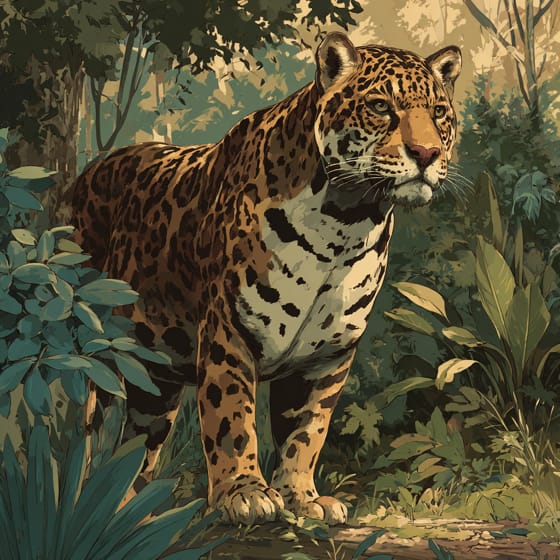
Panthera onca
Can ambush macaws near nests.
Ceiba pentandra
Uses hollows for nesting.
Describe a los animales, principalmente aves, que poseen una cubierta de plumas.
Los animales sociales viven en grupos organizados, cooperando para obtener beneficios de supervivencia como la búsqueda de alimento, la defensa y la cría de descendencia.
Colorido describe a organismos u objetos que exhiben una amplia variedad de colores brillantes y distintivos.
Este rasgo caracteriza a los organismos cuya dieta consiste total o principalmente en material vegetal.

Esta característica describe a los organismos que manipulan objetos externos para lograr un objetivo específico.

Los hábitats boscosos son entornos terrestres dominados por una densa cubierta arbórea, que sustentan una gran diversidad de vida animal y vegetal.

Este rasgo caracteriza a los organismos con una esperanza de vida excepcionalmente larga en comparación con otros de su especie.
Este rasgo de hábitat se refiere a las especies que se encuentran en las selvas tropicales, caracterizadas por una alta precipitación anual, gran biodiversidad y una densa cubierta arbórea.

Los animales diurnos están activos principalmente durante el día y suelen descansar o dormir por la noche.

El estado de peligro de extinción indica que una especie corre un riesgo muy alto de extinguirse en estado silvestre en un futuro próximo.
Peligro
1/5 · Muy bajo
Always watch birds from a distance and don't try to touch them in the wild.
90-95 cm
104-124 cm
1-1.7 kg
50-60 años
56 km/h
These colorful birds mostly feast on a rainbow of seeds, nuts, fruits, and even mineral-rich clay.
Forests
Foraging
Acércate para separar los grupos y explorar dónde se ha fotografiado este objeto.
Los snaps recientes aparecerán aquí a medida que se añadan nuevas observaciones.

Pennsylvania, US
Puedes ver Zorro Rojo, Western Barn Owl y Jaguar.
Ver guía →

Oklahoma, US
Puedes ver León Africano, Tigre y Rinoceronte Indio.
Ver guía →

England, UK
Puedes ver León Africano, Jirafas y Common Ostrich.
Ver guía →









