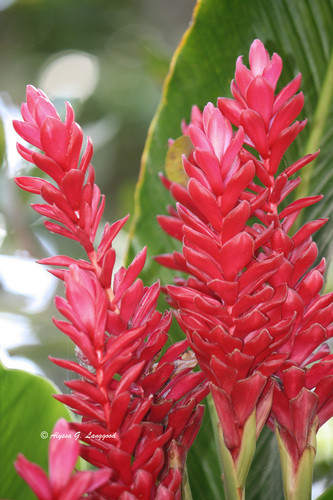


Red Ginger
alpinia purpurata
Red Ginger (Alpinia purpurata) is a striking herbaceous perennial plant native to the South Pacific islands, including Samoa, Vanuatu, and New Caledonia. Highly prized for its showy, plume-like flower spikes, it has been widely introduced and naturalized across humid tropical regions globally. What appear to be vibrant red petals are actually brightly colored bracts, which cleverly shield the plant's small, inconspicuous white flowers. This versatile plant thrives in warm, humid conditions and is highly integrated into tropical landscaping and the cut-flower industry.
Hábitat: Found in wet tropical forests, forest edges, and cultivated gardens, thriving in moist, well-draining soils with partial shade to full sun.
Red Ginger stands tall, typically reaching heights of 100 to 450 centimeters, characterized by large, oblong, shiny green leaves that measure up to 80 centimeters long. The defining feature is its terminal spike, which boasts numerous overlapping, leathery bracts of a brilliant crimson or pink hue. Peeking out from under these showy bracts are small, tubular white flowers. When the flower spike ages, small plantlets (bulbils) can often be seen growing directly from the inflorescence.
Categoría
PlantasRareza
Common
Peligro
1/5 · Muy bajo
Snaps
¡Sé la primera persona en hacer un snap!
It is the national flower of Samoa, where it is locally known as 'Teuila' and celebrated in annual cultural festivals.
Red Ginger can reproduce viviparously, meaning young clone plants sprout directly from the old flower stalks and take root once they fall to the ground.
The true flowers of the Red Ginger are actually tiny, white, and hidden inside the brilliant red structures, which are modified leaves called bracts.
The plant produces miniature plantlets directly within its old inflorescences, allowing them to drop to the ground and root as clones of the parent.
It possesses a robust root system capable of tolerating highly saturated soil conditions and short-term flooding.
Its brilliant red bracts act as long-distance visual signals to attract tropical pollinators to its tiny, hidden flowers.
As a photoautotrophic plant, Red Ginger synthesizes its own organic nutrients using sunlight, water, and carbon dioxide through photosynthesis.
Archilochus colubris
The Ruby-throated Hummingbird feeds on the nectar produced by the small white flowers hidden within the red bracts, acting as a key pollinator.
Pentalonia nigronervosa
Banana Aphids feed on the sap of young leaves and shoots, sometimes spreading plant viruses.
Aún no hay insignias de rasgos asignadas a este objeto.
Todavía no hay alias listados.
Las colecciones para este objeto aparecerán aquí a medida que se añadan más temas.
Peligro
1/5 · Muy bajo
Todavía no hay notas especiales de seguridad.
La forma más fácil de identificar a Red Ginger es usar la aplicación de identificación de naturaleza Snappit.
100-450 cm
5-15 años
As a photoautotrophic plant, Red Ginger synthesizes its own organic nutrients using sunlight, water, and carbon dioxide through photosynthesis.
Found in wet tropical forests, forest edges, and cultivated gardens, thriving in moist, well-draining soils with partial shade to full sun.
Acércate para separar los grupos y explorar dónde se ha fotografiado este objeto.
Los snaps recientes aparecerán aquí a medida que se añadan nuevas observaciones.