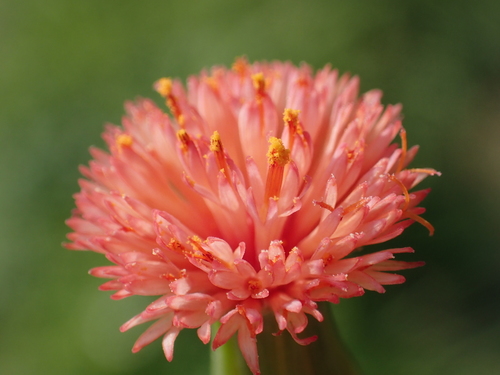


Red Tasselflower
emilia fosbergii
The Red Tasselflower (Emilia fosbergii), also known as Flora's paintbrush, is a charming and highly adaptable annual wildflower belonging to the aster family, Asteraceae. Native to the Old World tropics, this plant has successfully naturalized across many tropical and subtropical areas globally, including the Americas and various Pacific islands. It is well-regarded for its distinctive, brush-like flower heads that paint disturbed soils, grasslands, and roadsides with brilliant shades of crimson and deep pinkish-purple. Although it is frequently categorized as an agricultural weed, the Red Tasselflower plays a beneficial role in local ecosystems by offering a steady supply of nectar to diverse pollinators like butterflies, bees, and hoverflies. Its resilient nature allows it to quickly colonize barren or nutrient-poor soils, serving as an important pioneer species in ecological succession.
Hábitat: Typically found in sunny, disturbed soils, roadsides, agricultural fields, waste areas, and urban vacant lots within tropical and subtropical regions.
Standing between 20 and 100 centimeters tall, the Red Tasselflower features upright, slender stems that are smooth or minimally hairy and often branching near the top. Its leaves are highly variable, with the lower ones being lyre-shaped or deeply lobed, while the upper leaves are smaller, lance-shaped, and clasp the stem directly with their bases. The most striking identifier is the inflorescence, consisting of small, urn-shaped flower heads that lack outer petals (ray florets). Instead, they exhibit dense, brush-like clusters of bright red to purplish-pink tubular disc florets that project upward, giving the plant its paintbrush-like appearance.
Categoría
PlantasRareza
Common
Peligro
1/5 · Muy bajo
Snaps
¡Sé la primera persona en hacer un snap!
The common name 'Flora's paintbrush' is inspired by the flower heads, which look like tiny artist brushes that have been dipped in vibrant red paint.
The white fluff attached to its seeds resembles dandelion fluff, and children in tropical regions often blow the seed heads to watch the seeds float away.
While mostly considered a weed today, plants in the genus Emilia have been used in traditional folk remedies in various regions for soothing sore throats.
Each seed is equipped with a fluffy, white pappus that acts like a parachute, enabling wind currents to transport seeds far from the parent plant.
This species completes its life cycle within a few short months, allowing it to rapidly colonize newly cleared ground before other plants establish.
It thrives in highly disturbed, compacted, and low-nutrient soils where many other plant species fail to grow.
As a photoautotroph, the Red Tasselflower manufactures its own food by converting sunlight, carbon dioxide, and water into sugars via photosynthesis.
Agraulis vanillae
Feeds on the nectar of the flowers, aiding in pollination.
Cynodon dactylon
Competes for soil nutrients and sunlight in grassy lawns and disturbed pastures.
Aphis craccivora
Sucks nutrient-rich sap from the stems, potentially weakening the plant.
Aún no hay insignias de rasgos asignadas a este objeto.
Todavía no hay alias listados.
Las colecciones para este objeto aparecerán aquí a medida que se añadan más temas.
Peligro
1/5 · Muy bajo
Todavía no hay notas especiales de seguridad.
La forma más fácil de identificar a Red Tasselflower es usar la aplicación de identificación de naturaleza Snappit.
20-100 cm
1 años
As a photoautotroph, the Red Tasselflower manufactures its own food by converting sunlight, carbon dioxide, and water into sugars via photosynthesis.
Typically found in sunny, disturbed soils, roadsides, agricultural fields, waste areas, and urban vacant lots within tropical and subtropical regions.
Acércate para separar los grupos y explorar dónde se ha fotografiado este objeto.
Los snaps recientes aparecerán aquí a medida que se añadan nuevas observaciones.













