

Redmaids
calandrinia menziesii
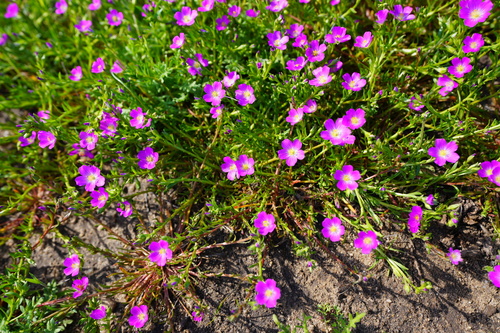
Redmaids (Calandrinia menziesii) is a vibrant, low-growing annual wildflower native to western North America. It is celebrated for its brilliant, bright pink to magenta flowers that blanket grassy fields, coastal scrubs, and agricultural areas during early spring. Appearing almost like brilliant jewels scattered across a green lawn, these hardy plants belong to the family Montiaceae and thrive in open, sun-drenched habitats. In addition to being a visual delight for hikers and nature enthusiasts, Redmaids play a crucial role in local ecosystems by attracting early-season pollinators and providing nutritious, oil-rich seeds for various birds and small mammals. Its ability to colonize disturbed soils makes it an important pioneer species after fires or soil cultivation.
Hábitat: Found in open, grassy areas, coastal scrublands, foothills, and disturbed soils or agricultural fields.
This low-growing, spreading plant typically reaches heights of 5 to 40 centimeters, featuring succulent, narrow, linear leaves that are fleshy and bright green. The most defining feature is the small, cup-shaped flowers, measuring about 1 to 2 centimeters across, which boast five petals in striking shades of intense magenta, deep pink, or occasionally white, surrounding numerous bright yellow stamens. The blossoms open fully only in bright, direct sunlight, creating dazzling carpets of color against the ground.
Categoría
PlantasRareza
Common
Peligro
1/5 · Muy bajo
Snaps
¡Sé la primera persona en hacer un snap!
Indigenous peoples of California traditionally harvested the tiny black seeds of Redmaids, roasting and grinding them into a rich, nutty pinole or pressing them into cakes.
Redmaid seeds are exceptionally rich in oil, containing up to 30% oil content, making them a high-energy food source for wildlife.
The genus name Calandrinia honors Jean Louis Calandrini, a respected 18th-century Swiss botanist and mathematician.
The flowers open only during warm, sunny hours and remain closed on cloudy days or during the night to protect their delicate pollen.
Their fleshy, thick leaves allow them to store moisture, helping the plant thrive in Mediterranean climates with dry spring spells.
The hard-coated seeds can remain dormant in the soil for years, germinating rapidly after fires or soil disturbances to quickly colonize open ground.
As a photosynthetic plant, Redmaids produce their own food using sunlight, water, and carbon dioxide while absorbing essential minerals from the soil.
Zenaida macroura
Mourning doves and other granivorous birds feed heavily on the highly nutritious, oil-rich seeds.
Halictus tripartitus
These native bees frequent the bright pink flowers for nectar and pollen, acting as effective pollinators.
Ceanothus diversifolius
Competes for soil nutrients and sunlight in post-fire chaparral recovery zones.
Aún no hay insignias de rasgos asignadas a este objeto.
Todavía no hay alias listados.
Las colecciones para este objeto aparecerán aquí a medida que se añadan más temas.
Peligro
1/5 · Muy bajo
Todavía no hay notas especiales de seguridad.
La forma más fácil de identificar a Redmaids es usar la aplicación de identificación de naturaleza Snappit.
5-40 cm
0.01-0.1 kg
1 años
As a photosynthetic plant, Redmaids produce their own food using sunlight, water, and carbon dioxide while absorbing essential minerals from the soil.
Found in open, grassy areas, coastal scrublands, foothills, and disturbed soils or agricultural fields.
Acércate para separar los grupos y explorar dónde se ha fotografiado este objeto.
Los snaps recientes aparecerán aquí a medida que se añadan nuevas observaciones.

California, US
Puedes ver Amapola De California y Lagartija De Manchas Laterales Común.
Ver guía →

California, US
Puedes ver Pino Gris, Caterpillar Scorpionweed y Roble De Gambel.
Ver guía →



_02.jpg&width=800)




.jpg&width=800)